Nagarhole-National-Park : Where Wilderness Comes Alive
Imagine the first pale light of dawn cutting through a cathedral of ancient trees, a herd of elephants moving silently through the mist, and the distant call of a peacock echoing across a still lake. This is Nagarhole — not merely a national park, but one of India's most extraordinary wildlife sanctuaries, where every rustle in the undergrowth could be a leopard, and every bend in the jungle trail holds a new wonder. Spread across approximately 643 square kilometres in the districts of Mysuru and Kodagu in Karnataka, Nagarhole (also officially known as Rajiv Gandhi National Park) is part of the celebrated Nilgiri Biosphere Reserve, one of the largest and most biodiverse protected landscapes in Asia.
🌿 Nagarhole National Park (Rajiv Gandhi), Karnataka – Where the Wild Calls and the Forest Listens
Imagine the first pale light of dawn cutting through a cathedral of ancient trees, a herd of elephants moving silently through the mist, and the distant call of a peacock echoing across a still lake. This is Nagarhole — not merely a national park, but one of India's most extraordinary wildlife sanctuaries, where every rustle in the undergrowth could be a leopard, and every bend in the jungle trail holds a new wonder. Spread across approximately 643 square kilometres in the districts of Mysuru and Kodagu in Karnataka, Nagarhole (also officially known as Rajiv Gandhi National Park) is part of the celebrated Nilgiri Biosphere Reserve, one of the largest and most biodiverse protected landscapes in Asia.
📜 A Little Bit of History First
The name "Nagarhole" comes from Kannada — naga meaning snake and hole meaning stream, a nod to the winding, serpentine river that flows through the heart of the forest. For centuries, this dense jungle was the private hunting grounds of the Mysore royal family, carefully guarded and left largely undisturbed. That royal protection, ironically, may be one of the reasons the forest survived so richly intact into modern times.
In 1955, it was declared a Wildlife Sanctuary, and in 1988 it was elevated to the status of a National Park. In 1999, it was renamed Rajiv Gandhi National Park in honour of the former Prime Minister. Shortly after, in 1999, it also became a Project Tiger Reserve, joining the elite network of protected habitats dedicated to saving India's Bengal tiger. Together with Bandipur National Park, Mudumalai Tiger Reserve, and Wayanad Wildlife Sanctuary, Nagarhole forms a vast, contiguous green corridor that is one of the last true wild frontiers on the Indian subcontinent.
🐅 The Wildlife That Will Leave You Speechless
🌟 Wildlife Highlights
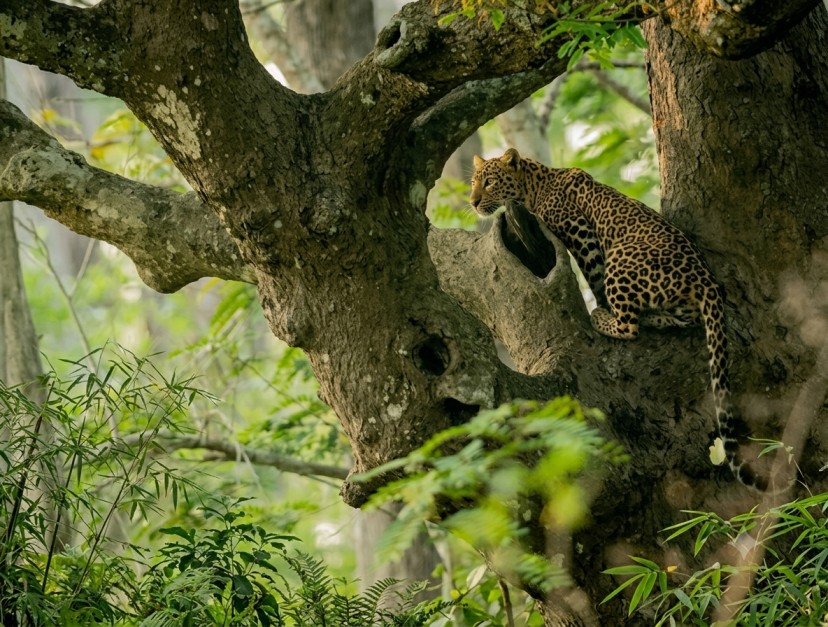
Nagarhole is, at its heart, a big cat country. The park is home to one of the highest densities of Bengal tigers in the world, and sightings — though never guaranteed, as any honest wildlife lover will tell you — are genuinely frequent compared to many other reserves. But tigers share the stage with Indian leopards, equally magnificent and arguably even more elusive, slipping through the dappled shade with liquid grace.
The Indian elephant is perhaps the park's most iconic resident. Nagarhole supports a large and thriving elephant population, and herds of 20, 30, or even 50 elephants moving together through the forest or gathering at the Kabini River at dusk is a sight that remains with you for the rest of your life.
Beyond the headliners, the park teems with life — gaur (Indian bison), the largest wild cattle species in the world, move through the forest like gentle giants. Spotted deer (chital) dart across clearings in graceful leaps. Sambar deer, wild boar, sloth bears, dholes (Indian wild dogs), four-horned antelopes, Indian giant squirrels, and mouse deer all call this jungle home. The birding alone is extraordinary — over 270 species have been recorded here, including the Malabar pied hornbill, crested serpent eagle, paradise flycatcher, Indian roller, and the vivid emerald dove.
The Kabini River and Reservoir, on the southern boundary of the park, is a world unto itself. During summer, as water levels drop, animals congregate in extraordinary numbers on its banks — making Kabini arguably one of the finest wildlife-watching spots in all of Asia.
🚙 Experiences That Go Beyond the Ordinary
Safari is the heart of any Nagarhole visit. Jeep safaris through the core zone in the early morning and late afternoon give you the best chance of big cat encounters, while elephant-back safaris (available at certain entry zones) offer a uniquely immersive way to move silently through the undergrowth. For a completely different perspective, boat safaris on the Kabini backwaters are extraordinary — watching elephants, gaur, and deer arrive at the waterline as the golden light fades is nothing short of magical.
Several nature walks and guided trekking experiences are available around the buffer zones, giving you a deeper feel for the forest's textures, sounds, and smaller wonders — the intricate world of butterflies, insects, wildflowers, and medicinal plants that the jeep simply rushes past.
📅 Best Time to Visit
The park is open from October to May, with the peak wildlife-watching season falling between March and May, when the dry conditions draw animals to waterholes and rivers in large numbers. October to February offers a more comfortable climate with lush green landscapes following the monsoon. The park remains closed during monsoon (June–September) to allow the forest to regenerate.
🚗 How to Get There
✈️ By Air
The nearest airport is Mysuru Airport (~96 km), with connections to Bengaluru. Kempegowda International Airport in Bengaluru (~240 km) offers broader national and international connectivity.
🚆 By Rail
Mysuru Railway Station is the closest major railhead (~96 km), well-connected to Bengaluru, Chennai, and other cities.
🛣️ By Road
Nagarhole is approximately 230 km from Bengaluru and 96 km from Mysuru. Karnataka State Road Transport Corporation (KSRTC) buses run to Hunsur, from where local transport connects to the park gates. Self-drive via the Mysuru–Hunsur–Kutta route is also a popular and scenic option.
📍 Nearby Places Worth Exploring
Bandipur National Park lies directly to the south and shares a continuous forest boundary — together they form an unbroken wildlife corridor. Coorg (Kodagu), one of India's most beautiful hill districts, is under an hour away and pairs beautifully with a Nagarhole visit. Mysuru, with its magnificent palace, silk bazaars, and rich culture, is perfect for a day trip. The Dubare Elephant Camp on the Cauvery River and the serene Bylakuppe Tibetan Settlement are also close by and deeply rewarding.
🌲 Why Nagarhole Deserves a Place on Every Traveller's Map
Some destinations show you the world as it is. Nagarhole shows you the world as it was — ancient, unhurried, and fiercely alive. This is a place where nature has not been curated for human comfort but simply allowed to be, in all its complexity and wildness. Whether you witness a tiger crossing a jungle road at dawn, watch a hundred elephants wade into the Kabini at sunset, or simply sit in the quiet dark of the forest and let the sounds wash over you — Nagarhole offers something that no city, no screen, and no travel highlight reel can replicate: the profound, humbling reminder that we share this planet with creatures far older and more magnificent than ourselves.
Pack your binoculars, your patience, and your sense of wonder. The jungle is waiting.