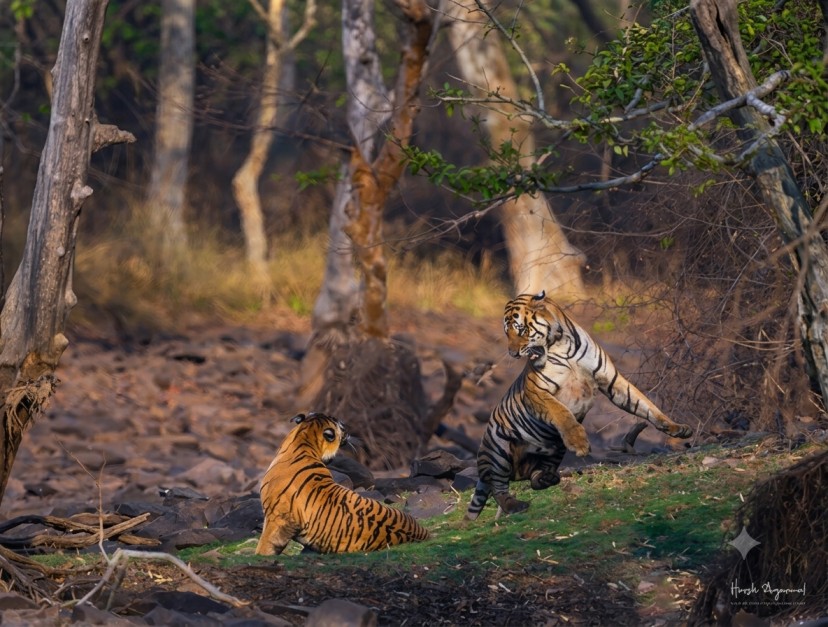
Panna-National-Park : Where Wilderness Meets Serenity
Imagine standing at the edge of a rugged gorge, the Ken River glinting silver far below, while a leopard disappears silently into the teak forest above you. No sound but the wind, a distant birdcall, and your own breath catching in your throat. That's Panna for you — not just a national park, but a resurrection story. Tucked into the Vindhyan ranges of northern Madhya Pradesh, this extraordinary wilderness sits at an elevation of roughly 390 to 500 metres and carries within it one of conservation's most remarkable second chances. Once declared tiger-free, Panna clawed its way back. And today, it wears that comeback like a crown.
🐅 Panna National Park, Madhya Pradesh – Where the Wild Reclaims Its Throne
Imagine standing at the edge of a rugged gorge, the Ken River glinting silver far below, while a leopard disappears silently into the teak forest above you. No sound but the wind, a distant birdcall, and your own breath catching in your throat. That's Panna for you — not just a national park, but a resurrection story. Tucked into the Vindhyan ranges of northern Madhya Pradesh, this extraordinary wilderness sits at an elevation of roughly 390 to 500 metres and carries within it one of conservation's most remarkable second chances. Once declared tiger-free, Panna clawed its way back. And today, it wears that comeback like a crown.
📜 A Little Bit of History First
Panna's story is as dramatic as the landscape itself. The park takes its name from the diamond-rich town of Panna nearby — a region that has dazzled the world with its gems for centuries. The forests here were once the royal hunting grounds of the Panna princely state, and the wildlife thrived under their careful, if contradictory, stewardship.
In 1981, Panna was declared a Wildlife Sanctuary, and by 1994, it earned the prestigious status of a Tiger Reserve under Project Tiger. For a while, it was a celebrated success. Then, between 2005 and 2009, the unthinkable happened — every last tiger was poached. Panna was declared locally extinct of tigers, a heartbreaking collapse that shocked conservationists across the country.
What followed, however, is the part that gives you goosebumps. Between 2009 and 2011, tigers were translocated from Bandhavgarh and Kanha to Panna in a bold reintroduction programme. The forests responded. The prey base recovered. The big cats settled in, found mates, and bred. Today, Panna has over 70 tigers — a wildlife miracle that is now studied and celebrated globally. This is a park that refused to give up.
🌿 The Attractions That Will Leave You Breathless
🚤 The Ken River
The Ken River is the lifeline of Panna, flowing through the heart of the reserve and carving dramatic gorges that are among the most visually stunning in central India. A boat safari on the Ken offers an entirely different perspective — you drift silently past crocodiles sunning themselves on banks, gharials gliding below the surface, and kingfishers flashing electric blue between the reeds.
🐊 Ken Gharial Sanctuary
The Ken Gharial Sanctuary, which shares its boundary with the park, is one of the last remaining strongholds of the critically endangered gharial. Watching these ancient, long-snouted reptiles is a humbling reminder of how close some species teeter on the edge.
🚙 Jeep Safaris
For the big game enthusiast, jeep safaris through the core zones — Madla, Hinauta, and Jhinna gates — offer the best chances of spotting tigers, leopards, sloth bears, wolves, and the impressively large herds of chital and sambhar that roam these teak-and-grassland corridors.
💧 Pandav Falls and Caves
Don't miss the Pandav Falls and Caves, where the Ken tumbles dramatically over rocks into a plunge pool fringed by jungle. According to local legend, the Pandavas spent part of their exile in the caves here, and the site carries a mythic weight that adds poetry to the landscape.
🦅 Panna's Remarkable Wildlife
Beyond tigers and gharials, Panna is a biodiversity treasure chest. The park is home to over 200 species of birds, making it a paradise for birdwatchers. Look out for the Indian vulture, painted stork, paradise flycatcher, red-headed vulture, and the rare white-naped woodpecker among the canopy. Raptors circle the gorges all day long.
Mammals include wolves, wild dogs (dholes), hyenas, jungle cats, four-horned antelopes, and enormous populations of nilgai. The Ken's aquatic corridors shelter the smooth-coated otter, a species increasingly rare across the subcontinent. Panna truly delivers across the entire food chain.
🏡 Culture, People, and Local Life
The villages surrounding Panna carry a quiet, unhurried character shaped by the rhythms of the forest and the ancient traditions of the Gond and Baiga tribal communities. Their relationship with the land is rooted in reverence, and their knowledge of local plants, animals, and forest ecology is extraordinary.
The town of Panna itself is deeply associated with the diamond mining legacy of the region. The Panna Diamond Mines, managed by the National Mineral Development Corporation, are among the only diamond mines open to the public in Asia. A short visit to the mining area is a fascinating detour into a world most travellers never see.
The local cuisine is simple, earthy, and deeply satisfying — dal, baati, churma, and other Bundelkhandi staples cooked over wood fire and served with generous warmth. If you get the chance to eat at a local home-stay, do not refuse.
📅 Best Time to Visit
The park is open from October to June, with the forests closed during the monsoon. The winter months from November to February are ideal — wildlife is active, the air is crisp, and the mornings in the forest are gloriously atmospheric. March to June is arguably the best time for tiger sightings, as the deciduous forest sheds its leaves and the animals concentrate around water sources. April and May can be hot, but the sightings are often spectacular.
🚗 How to Get There
✈️ By Air
By Air: The nearest airports are Khajuraho Airport (HJR), just 25 km away, well-connected to Delhi and Varanasi, and Jabalpur Airport, about 160 km from Panna.
🚆 By Rail
By Rail: Satna Railway Station, approximately 90 km away, is the most convenient railhead, connected to major cities including Delhi, Bhopal, and Jabalpur. Taxis and cabs are readily available from the station.
🛣️ By Road
By Road: Panna is well-connected by road. From Khajuraho, it's a smooth 25 km drive. Madhya Pradesh Tourism operates vehicles, and private taxis from Satna, Bhopal, and Jabalpur can be arranged easily.
📍 Nearby Places Worth Exploring
Panna's position in the heart of Madhya Pradesh puts you within reach of some of India's finest heritage and wildlife destinations. Khajuraho, with its world-famous UNESCO-listed temples celebrating life in all its forms, is just 25 km away — an absolute must-see. Bandhavgarh National Park is about 200 km distant and pairs beautifully with Panna for a multi-destination wildlife itinerary. The ancient temples of Ajaygarh Fort and Kalinjar Fort — medieval marvels of stone and history — are within comfortable driving distance. And the ancient city of Orchha, with its stepped temples and riverside cenotaphs, makes for a deeply atmospheric day trip.
🎒 A Few Travel Tips Before You Go
Book your safari permits in advance, especially during peak season — slots fill quickly. Safari timings are typically early morning and late afternoon; the golden hours are best for both wildlife and photography. Carry neutral-coloured clothing — avoid bright colours in the forest. Binoculars are essential. Most importantly, go slow and stay quiet. The forest rewards patience more than speed.
🐅 Why You Simply Must Visit Panna
Some wildlife destinations offer you a show. Panna offers you a story — one still being written, one that involves human failure, collective remorse, and extraordinary redemption. To walk these forests is to walk inside a conservation miracle.
Whether you're a seasoned wildlife photographer, a curious first-time safari-goer, a birder with a list to tick, or simply someone who craves the kind of silence only deep forest can provide, Panna will give you more than you came for. The tiger padding through the undergrowth, the gharial slipping beneath the Ken's green surface, the vulture riding a thermal above the gorge — these are not just sightings. They are reminders that nature, when given half a chance, fights back.
So let the road carry you to Panna. The wild is waiting — and it has quite a story to tell.