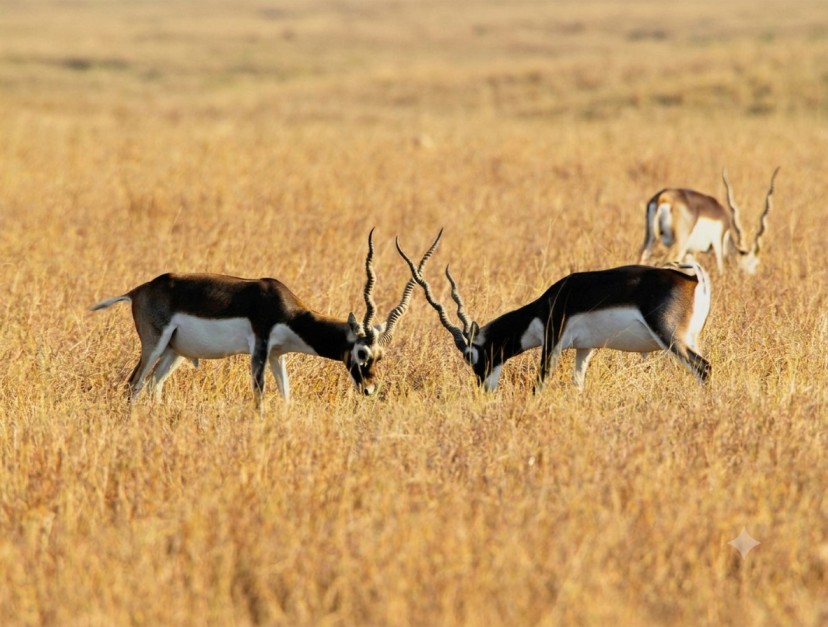
Velavadar-National-Park : The Land Of Blackbucks
Imagine standing at the edge of an open, golden grassland as the sun dips low on the horizon, painting the sky in shades of copper and rose. Suddenly, a herd of blackbuck breaks into a sprint — fluid, effortless, impossibly graceful — and for a moment, the world holds its breath. That's Velavadar for you — not just a wildlife reserve, but a revelation. Tucked into the Bhavnagar district of Gujarat's Saurashtra region, this compact yet extraordinary national park sits about 65 kilometres from Bhavnagar city. Small in size but enormous in soul, Velavadar is one of India's best-kept wildlife secrets — and those who find it, never quite forget it.
🌾 Velavadar National Park, Gujarat – Where the Grasslands Come Alive
Imagine standing at the edge of an open, golden grassland as the sun dips low on the horizon, painting the sky in shades of copper and rose. Suddenly, a herd of blackbuck breaks into a sprint — fluid, effortless, impossibly graceful — and for a moment, the world holds its breath. That's Velavadar for you — not just a wildlife reserve, but a revelation. Tucked into the Bhavnagar district of Gujarat's Saurashtra region, this compact yet extraordinary national park sits about 65 kilometres from Bhavnagar city. Small in size but enormous in soul, Velavadar is one of India's best-kept wildlife secrets — and those who find it, never quite forget it.
📜 A Little Bit of History First
Velavadar's story is rooted in the land itself. The name comes from the local village of Velavadar, and the park's grasslands — known locally as bets — were historically used as grazing reserves for the Gaekwad rulers of Baroda. For centuries, these wide-open savannahs served as royal hunting grounds, which paradoxically helped preserve them from large-scale agricultural encroachment.
In 1969, recognising the ecological significance of this landscape, the Gujarat government declared the area a wildlife sanctuary. It was upgraded to a National Park in 1976, encompassing approximately 34.08 square kilometres of pristine grassland habitat. Today, it stands as one of the finest examples of the Indian tropical dry grassland ecosystem — a habitat type that has largely disappeared from the subcontinent, making Velavadar's preservation all the more precious.
🦌 The Attractions That Will Leave You Breathless
🌟 Blackbuck Kingdom
Velavadar is, first and foremost, the kingdom of the Indian Blackbuck (Antilope cervicapra). This park holds one of the highest densities of blackbuck anywhere in the world, with over 3,000 individuals roaming freely across its open plains. Watching a dominant male — his spiralling horns catching the morning light, his jet-black and white coat gleaming — strut across the grassland is one of the most iconic wildlife sightings in all of India.
🦅 Birdwatcher's Paradise
But Velavadar is far more than its blackbuck. The park is famous among birders as the winter home of the Eurasian Harrier, with up to 10 different harrier species roosting here between November and February — a spectacle rarely seen anywhere else on Earth. The Lesser Florican, one of India's most endangered birds, performs its extraordinary jumping courtship display here during the monsoon months, a sight that draws ornithologists from across the globe.
🐺 Predators of the Plains
Keep your eyes on the grasslands for the elusive Wolf (Canis lupus pallipes), which still prowls these plains in small packs. Striped Hyena, Jungle Cat, Indian Fox, and the occasional Nilgai round out a wildlife roster that punches far above the park's modest size. The flat, open terrain makes wildlife spotting remarkably easy — this is one of the few places in India where you can see predator and prey in open country, without the dense forest obscuring the drama.
🌅 Harrier Roost Experience
The Harrier roost at dusk is an unmissable experience. As the sky turns amber, hundreds of harriers spiral down to roost in the tall grass — swirling, calling, descending in waves — a natural performance that will leave even non-birders completely spellbound.
🎭 Culture, People, and Food
The villages surrounding Velavadar are home to the Bharwad and Ahir communities, pastoral people whose lives have been intertwined with these grasslands for generations. Their brightly coloured traditional clothing, intricate embroidery, and deeply musical culture offer a warm glimpse into rural Gujarat's rich heritage.
The nearest town of Bhavnagar is a treasure trove of Gujarati culture. Explore the Takhteshwar Temple perched atop a small hill for sweeping city views, or visit the Gandhi Smriti Museum to trace the region's connection to the Mahatma. The old city's bazaars buzz with artisans crafting bidriware, tie-and-dye fabrics, and silverwork.
Food in this region is quintessentially Gujarati — wholesome, vegetarian, and deeply satisfying. Begin your mornings with thepla, dhokla, and a glass of sweet, milky chai. In Bhavnagar's local eateries and dhabas, don't miss dal baati, undhiyu (especially in winter), and the famous Gujarati thali — a glorious spread of flavours that manages to be simultaneously sweet, spicy, tangy, and savoury all at once.
📅 Best Time to Visit
Velavadar is open throughout much of the year, but the experience changes beautifully with the seasons. November to February is the prime season — the weather is cool, the harriers are in residence, the blackbuck herds are large, and wildlife activity is at its peak. July to October (monsoon and post-monsoon) is spectacular for birders chasing the Lesser Florican's courtship display, and the grasslands turn an impossibly vivid green. March to May is warmer but good for spotting wolves, as the dry grass offers clear sightlines across the plains.
🚗 How to Get There
✈️ By Air
By Air: The nearest airport is Bhavnagar Airport (BHU), with regular flights connecting to Ahmedabad. From Bhavnagar, the park is roughly 65 km by road — about 90 minutes by taxi or cab.
🚆 By Rail
By Rail: Bhavnagar Railway Station is the closest railhead, well-connected to Ahmedabad, Surat, and Mumbai. Taxis and auto-rickshaws are available for the onward journey to the park.
🛣️ By Road
By Road: Velavadar is easily accessible from Bhavnagar via State Highway 34. Gujarat State Road Transport Corporation (GSRTC) buses run regularly between Bhavnagar and nearby towns. Private taxis are the most convenient option for reaching the park gates directly, especially since jeep safaris operate from inside the park.
📍 Nearby Places Worth Exploring
The Saurashtra region surrounding Velavadar is extraordinarily rich. Bhavnagar city (65 km) offers heritage palaces, museums, and excellent Gujarati cuisine. Lothal (around 100 km north), one of the most important archaeological sites of the ancient Indus Valley Civilisation, is a humbling journey back 4,500 years in time. Palitana (about 50 km), home to the spectacular Shatrunjaya Hill with its 900+ Jain temples, is a UNESCO Tentative World Heritage Site and a deeply moving pilgrimage destination. Further afield, the Gir National Park — home to the last Asiatic Lions — is about 4 hours away and pairs beautifully with a Velavadar visit for a definitive Gujarat wildlife circuit.
🎒 A Few Travel Tips Before You Go
Book safari permits in advance, especially during peak winter season, as visitor numbers are limited to protect the ecosystem. Carry binoculars — Velavadar's flat terrain rewards patient observation, and the harrier spectacle simply cannot be fully appreciated without them. Wear neutral, earthy colours to avoid startling the wildlife. The nearest accommodation options range from the forest department's own Black Buck Lodge inside the park to hotels in Bhavnagar — staying inside the park dramatically enhances your dawn and dusk safari experiences.
🌾 Why You Simply Must Visit Velavadar
Some national parks demand you work hard for your wildlife — days in the jungle, early starts, long waits in the heat. Velavadar gives itself to you openly, generously, almost immediately. Step out of your vehicle at the park entrance and the blackbuck are already watching you from a hundred yards away, calm and curious. Look up at dusk, and the sky fills with raptors. Listen carefully at dawn, and the grassland speaks in a hundred bird voices at once.
This is a place that reminds you how extraordinary the ordinary world can be — a landscape that asks nothing of you except that you slow down, look up, and pay attention. Whether you're a dedicated wildlife photographer, a passionate birder, or simply someone who finds peace in open skies and unhurried land, Velavadar will give you something rare: the feeling that the wild world is not as far away as you feared.
So go. Stand in those golden grasslands. Watch the blackbuck run. Let the harriers spiral above you in the fading light. And carry it with you long after you've gone home.