🏛️ Khajuraho Group of Monuments (Madhya Pradesh)
📖 Overview
The Khajuraho Group of Monuments stands as one of the most remarkable and philosophically rich heritage destinations in India, representing an extraordinary confluence of art, spirituality, and architectural excellence. Built between the 9th and 12th centuries by the Chandela dynasty, this UNESCO World Heritage Site originally consisted of over 80 temples, of which around 20 survive today in exceptional condition. Located in a tranquil and relatively remote region of Madhya Pradesh, Khajuraho offers a unique experience where silence, space, and history combine to create a deeply immersive atmosphere.
What distinguishes Khajuraho from other heritage sites is not merely its architectural brilliance, but the layered narrative embedded within its sculptural program. The temples are adorned with thousands of intricately carved figures depicting deities, celestial beings, dancers, musicians, warriors, and scenes from everyday life. These carvings collectively express a holistic vision of human existence, where spirituality and worldly life are intertwined rather than separated. This philosophical depth elevates Khajuraho beyond a conventional sightseeing destination into a place of reflection and cultural discovery.
✨ Why Visit Khajuraho
The recognition of Khajuraho as a UNESCO World Heritage Site reflects its universal cultural importance and its outstanding contribution to the history of temple architecture in India. Unlike isolated monuments, Khajuraho offers a complete and cohesive temple complex where architecture, sculpture, and spatial planning work together to create a unified artistic vision.
One of the most compelling reasons to visit Khajuraho is its extraordinary sculptural detail. While widely known for its erotic imagery, these sculptures form only a small portion of the overall carvings and must be understood within a broader symbolic context. The artwork represents various stages of life, human emotions, and spiritual evolution, reflecting ancient Indian philosophies that embrace the totality of existence.
🗿 Key Highlights Within the Complex
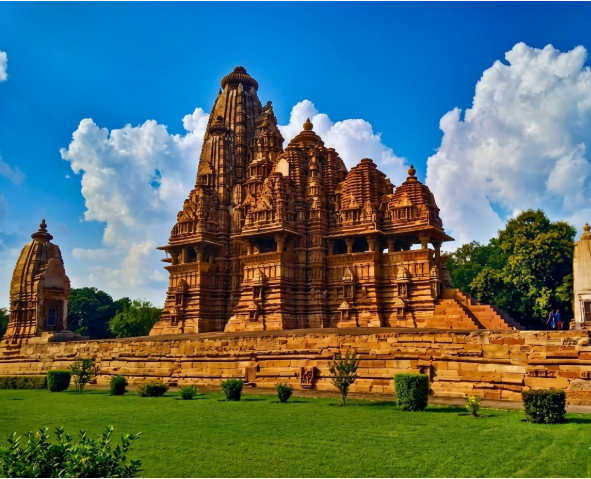
Among the surviving structures, the Kandariya Mahadev Temple stands out as the most iconic and architecturally sophisticated. Its towering shikhara (spire) rises dramatically above the landscape, surrounded by smaller subsidiary spires that create a rhythmic and harmonious composition. The exterior is densely covered with sculptures that appear almost alive, capturing movement and emotion with remarkable realism.
The Lakshmana Temple is another major highlight, known for its balanced proportions and intricate detailing. Dedicated to Lord Vishnu, it features elaborate carvings that depict mythological narratives alongside scenes of courtly life, providing valuable insight into the social and cultural environment of the time.
🚶 Activities
Heritage exploration is the primary activity at Khajuraho, with guided tours playing a crucial role in enhancing the experience. Professional guides provide context for the sculptures, explain their symbolic meanings, and share historical insights about the Chandela dynasty, allowing visitors to engage more deeply with the site.
Photography is a major highlight, as the temples offer countless opportunities for capturing architectural detail and artistic expression. Early morning and late afternoon are particularly favorable for photography, as the softer light enhances the natural tones of the sandstone and highlights the intricate carvings.
🌤️ Best Time to Visit
The most favorable period to visit Khajuraho is from October to March, when the weather is pleasant and suitable for exploring the open temple complex. During these months, temperatures remain moderate, allowing visitors to comfortably spend extended periods outdoors.
🚗 Connectivity
Khajuraho is well connected despite its relatively remote setting. The nearest airport is Khajuraho Airport, located just a short distance from the temple complex, with flights connecting to major cities such as Delhi and Varanasi. The Khajuraho Railway Station provides rail access, while larger nearby railheads such as Jhansi and Satna offer broader connectivity across India.
Road connectivity is efficient, with well-maintained highways linking Khajuraho to other important destinations in Madhya Pradesh and neighboring states. This makes it a convenient inclusion in extended travel itineraries across central India.
⏳ Suggested Duration and Target Market
A stay of one to two days is recommended to fully experience Khajuraho. While the main highlights can be covered in a single day, an extended stay allows for a more relaxed exploration, including revisiting key temples at different times of day and participating in additional cultural experiences.
Khajuraho is particularly appealing to heritage travelers, cultural enthusiasts, historians, photographers, and international visitors seeking an in-depth understanding of India’s artistic and philosophical traditions. It is also a key destination for curated and luxury travel itineraries, offering a unique combination of cultural depth and visual grandeur
Adventure sports around