Mawphlang
A Khasi Hills village built around an ancient sacred grove, kept intact for centuries under traditional Khasi custom, roughly 25 km from Shillong.
A forest kept by custom, not by fence
Mawphlang sits a short drive from Shillong in the East Khasi Hills, built around the Mawphlang Sacred Grove, one of India's oldest protected forests. The grove's protection comes from Khasi spiritual belief rather than formal conservation law, which shapes how any visit needs to be conducted on the ground.
Access into the grove itself requires an authorized local guide, and the no-removal rule for any natural material is strictly enforced by the community. This is a structural constraint for itinerary design, not a soft recommendation.
At a glance
| Nearest airport | Shillong Airport; Guwahati for wider connectivity |
| Rail access | Guwahati Railway Station |
| Road route | Shillong → Mawphlang by taxi or local bus, scenic Khasi Hills drive |
| Grove access | Authorized local guide required |
| Conduct | No removal of leaves, flowers, stones, or branches from the grove |
Operating window
October through April brings cool, pleasant weather best suited to trekking and sightseeing. Monsoon months (June–September) bring heavy lushness but slippery trails, useful context if green-season visuals are part of the brief.
What an itinerary draws on
Sacred Grove
Centuries-old trees, sacred monoliths, natural springs, and rare medicinal plants across roughly 80 hectares of protected canopy.
David Scott Trail
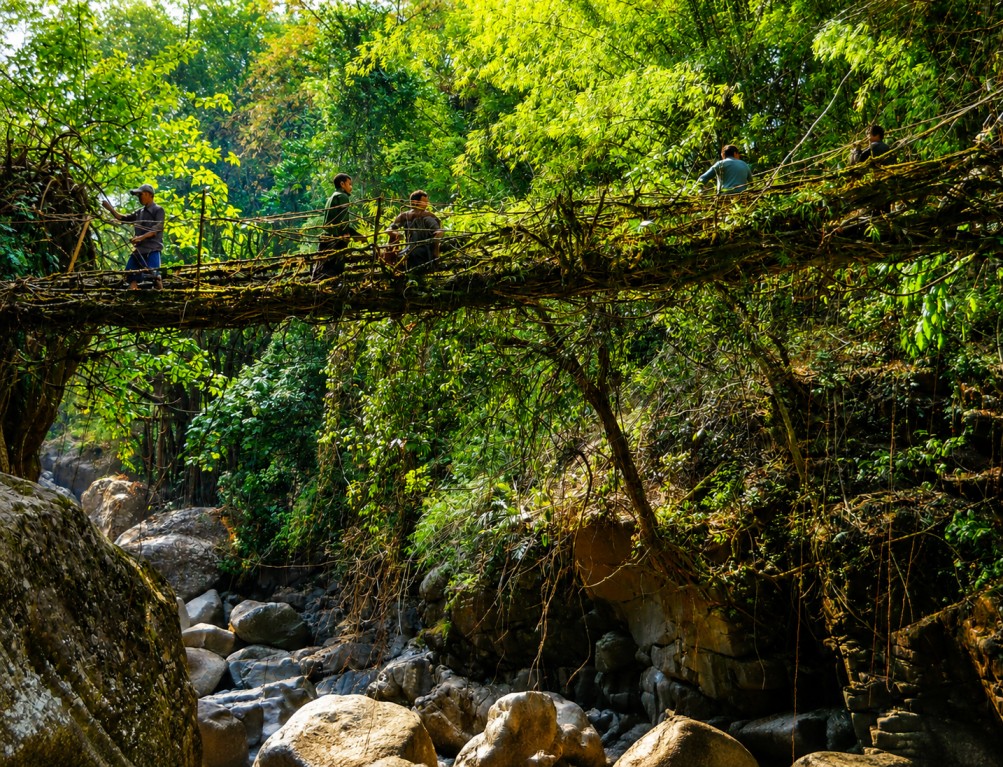
A historic trekking route through villages, forest, and streams, named for the British administrator who first opened it.
Khasi Heritage Village
Traditional Khasi architecture and cultural artifacts, and host venue for the annual Monolith Festival.
Inside the grove
The grove and surrounding forest carry exceptional plant diversity alongside a working population of forest fauna, relevant for botanically or ecologically themed itineraries.
Cuisine and craft
Khasi cuisine
Jadoh, Dohneiiong, Tungrymbai, bamboo shoot preparations, smoked meat, and fresh local vegetables and fruit.
Craft, village and nearby Shillong
Bamboo and cane products, Khasi textiles, traditional baskets, organic honey, and handmade jewelry.
Planning constraints
| Gear | Comfortable trekking shoes, rain protection, layered clothing for changeable weather |
| Guide booking | Authorized grove guide must be arranged in advance |
| Trail condition | David Scott Trail can be slippery in monsoon months |
| Local conduct | Strict no-removal policy in the Sacred Grove; standard leave-no-trace practice elsewhere Best Places to Explore Nearby |