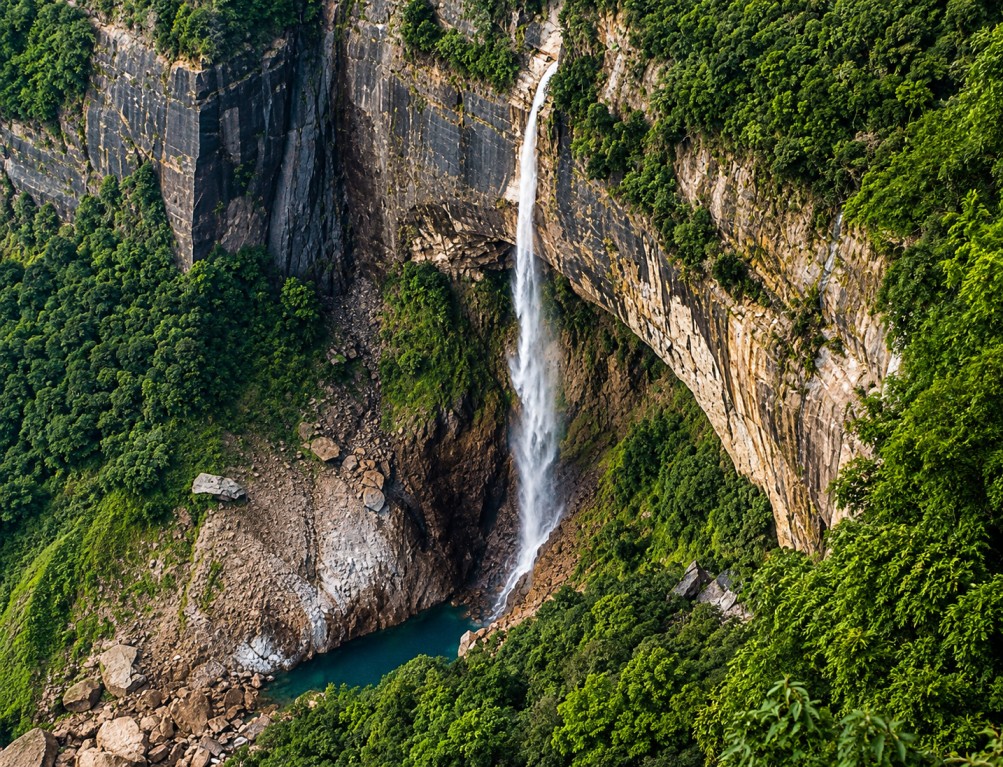
💧 Nohsngithiang Falls (Meghalaya)
Nohsngithiang Falls stands as one of the most breathtaking and visually magnificent natural destinations in northeastern India, representing a waterfall of extraordinary scale and dramatic beauty that plunges in seven distinct segmented streams from the edge of a vast plateau cliff into a deep and misty gorge far below, creating a spectacle of falling water that is widely regarded as one of the most spectacular natural sights in the entire Indian subcontinent.
Situated near the town of Cherrapunji, also known as Sohra, in the East Khasi Hills district of Meghalaya, Nohsngithiang Falls, popularly referred to as the Seven Sisters Falls in reference to the seven northeastern states of India, is a destination of singular natural grandeur, offering a landscape defined by the immense sandstone plateau edge from which the falls descend, the layered curtains of white water dropping nearly three hundred and fifteen metres into the gorge below, the vast forested valley of Bangladesh spreading to the horizon far beneath, and an atmosphere of elemental natural power and highland mist that makes this one of the most emotionally overwhelming landscape experiences available anywhere in the region.
The destination draws nature enthusiasts, waterfall seekers, photographers, and adventurous travelers from across the country and beyond, offering an encounter with rainfall, geology, and topography combined at a scale and with a drama that few natural sites anywhere in India can match.
🌟 What Distinguishes These Falls
What distinguishes Nohsngithiang Falls from other waterfall destinations in the subcontinent is not merely the height or the visual drama of its seven parallel streams, but the unique combination of extraordinary geological setting, the extraordinary rainfall heritage of Cherrapunji as one of the wettest places on earth, the vast panoramic view across the plains of Bangladesh that frames the falls from the viewing plateau above, and the living Khasi cultural landscape embedded within the highland plateau from which the falls descend. The falls are at their most overwhelming during and immediately following the monsoon months when the full volume of Cherrapunji's legendary rainfall feeds every one of the seven streams to their maximum width and power, transforming the cliff face into a wall of white water of almost incomprehensible visual force. This layered character elevates Nohsngithiang Falls beyond a simple scenic waterfall into a destination of genuine natural wonder and geographical discovery of the highest order.
🎯 Why Visit Nohsngithiang Falls
The recognition of Nohsngithiang Falls as one of the most spectacular waterfalls in Asia reflects its unparalleled importance within the natural heritage landscape of northeastern India and its standing as the single most visually dramatic natural feature of a region already extraordinary in its scenic richness. Unlike single-stream waterfalls or more conventionally accessed natural attractions, Nohsngithiang offers a cohesive experience where the seven parallel curtains of descending water, the vast cliff edge of the Cherrapunji plateau, the misty gorge far below, and the boundless panorama of the Bangladesh plains together create a natural spectacle of exceptional scale and emotional power.
One of the most compelling reasons to visit is the sheer physical scale of the visual experience, which operates simultaneously at multiple levels of grandeur. From the viewing point on the plateau edge, the falls drop away beneath in a descent so deep that the base is frequently lost in cloud and mist, while the seven streams spread across the cliff face in a width that requires the eye to sweep from side to side to take in the full extent of the cascade. The knowledge that this water has fallen on the plateau above from clouds that have traveled from the Bay of Bengal and risen against the Khasi hills in one of the most intense rainfall regimes on the planet adds a geographical and atmospheric dimension to the visual spectacle that deepens its significance considerably.
Additionally, Nohsngithiang Falls showcases the broader natural richness of the Cherrapunji plateau, which combines the waterfall spectacle with living root bridges in the valleys below, the sacred forests of the Khasi community, and a landscape of extraordinary botanical diversity nourished by the exceptional rainfall that feeds every stream and waterfall of this remarkable highland. The combination of natural spectacle of global significance, the unique cultural landscape of the Khasi hills, and the dramatic geographical setting at the edge of the plateau overlooking the plains of Bangladesh further strengthens its appeal as a destination of profound and lasting natural discovery.
🏞️ Key Highlights Within the Area
🌊 The Seven Segmented Streams
Among the natural landmarks, the seven segmented streams of Nohsngithiang Falls themselves stand out as the most iconic and overwhelmingly spectacular feature of the site. Descending from the plateau edge in parallel curtains of white water that separate and merge with the shifting force of the flow, the falls present a visual experience of extraordinary complexity and scale, with each individual stream carrying its own character and volume while together composing a unified spectacle of natural power across the full width of the cliff face. During the monsoon months, when all seven streams run at full capacity, the combined roar of the falling water fills the plateau air with a sound of elemental natural force that is felt as much as heard.
👁️ The Viewing Plateau
The viewing plateau above the falls, from which the full extent of the cascade and the vast panorama of the landscape below are simultaneously visible, is another landmark of exceptional natural and geographical significance. Standing at the plateau edge with the falls descending into the mist far below and the flat green expanse of the Bangladesh plains stretching uninterrupted to the horizon beyond, the visitor occupies a vantage point of extraordinary geographical drama where the abrupt transition from the highland plateau to the lowland plains is experienced with a visceral and immediate physical intensity that maps and photographs cannot adequately convey.
🪨 Mawsmai Cave
The Mawsmai Cave, located a short distance from the falls within the Cherrapunji area, adds a significant geological dimension to the visit. Carved by millennia of water movement through the limestone of the Khasi hills, the cave system features chambers of considerable size and formations of stalactites and stalagmites of varying scale and character, offering a subterranean encounter with the geological forces that have shaped this remarkable landscape over millions of years.
🌤️ Seasonal Visual Variations
The visual experience of Nohsngithiang changes dramatically with the season and the weather, as the monsoon months bring the falls to their most overwhelming and visually spectacular state, with all seven streams at full volume and the mist rising from the gorge to meet the low cloud drifting across the plateau above, while the drier winter months reveal the individual character of each stream more clearly against the exposed rock face, offering a different and equally rewarding visual encounter with the waterfall in its calmer seasonal expression.
🚶 Activities
Viewing the falls from the designated plateau viewpoint is the primary and most celebrated activity at Nohsngithiang, with the broad viewing area providing unobstructed perspectives across the full width of the cascade and the vast landscape beyond, offering conditions for extended contemplation and photography of a natural spectacle that rewards unhurried observation across the changing light and weather conditions of the highland plateau. The viewpoint is most dramatically experienced in the early morning, when the mist is heaviest in the gorge below and the falls emerge from and disappear into cloud in a display of atmospheric natural beauty of exceptional power.
Photography of the falls across the varying light and atmospheric conditions of the plateau day is a deeply rewarding pursuit that draws serious and amateur photographers from across the country, as the combination of the seven segmented streams, the depth of the gorge, the panoramic backdrop of the Bangladesh plains, and the ever-shifting mist and cloud of the Cherrapunji climate offers natural photographic material of extraordinary variety and visual richness at virtually every hour of the day and every phase of the monsoon season.
🥾 Exploring the Broader Cherrapunji Landscape
Exploring the broader Cherrapunji landscape through visits to the living root bridges of Nongriat, the Eco Park overlooking the Bangladesh plains, the Nohkalikai Falls located a short distance away and among the tallest plunge waterfalls in India, and the sacred forests and village landscapes of the Khasi plateau offers a deeply rewarding extension of the Nohsngithiang visit into a fuller engagement with one of the most naturally extraordinary landscapes in northeastern India. The descent to the living root bridges of the Nongriat valley, undertaken as a moderately demanding trek through subtropical forest, rewards those who make the effort with an encounter with one of the most remarkable examples of living architecture found anywhere in the world.
📅 Best Time to Visit
The monsoon season from June to September, and particularly the months of July and August when the rainfall over the Cherrapunji plateau reaches its legendary intensity, brings the falls to their most overwhelming and visually dramatic state, with all seven streams running at maximum volume and the cascade presenting a spectacle of natural power and scale that is simply unavailable at any other time of year. Visitors who can accept the persistent rainfall and occasional mist that obscures the falls entirely for periods during heavy rain are rewarded with a natural experience of rare and overwhelming force.
The winter months from October to March offer a contrasting but equally rewarding visit, with the falls reduced in volume but individually more visible and distinct against the exposed cliff face, the skies clearing to offer the sharpest and most extensive views across the Bangladesh plains, and the comfortable highland temperatures making extended time at the viewpoint and exploration of the surrounding plateau landscape particularly enjoyable. The post-monsoon months of October and November are particularly rewarding, as the landscape retains its full monsoon greenery while the rainfall diminishes and the visibility improves dramatically.
The summer months of April and May bring moderate conditions to the Cherrapunji plateau and the falls maintain a reasonable flow as the pre-monsoon rainfall begins to build, though the most spectacular conditions remain those of the full monsoon season when the Khasi hills receive the rainfall that has made Cherrapunji one of the most celebrated geographical phenomena on earth.
The most favorable period to visit Nohsngithiang Falls divides naturally into two distinct and contrasting experiences, each offering a different encounter with the falls and the surrounding landscape.
🛣️ Connectivity
🚗 From Shillong to Cherrapunji
Nohsngithiang Falls is conveniently accessible from Shillong, the capital of Meghalaya, situated approximately 54 kilometres from Cherrapunji by a scenic mountain road that descends through the forested Khasi hills before climbing again onto the Cherrapunji plateau. The journey from Shillong to Cherrapunji takes approximately one and a half to two hours by road and passes through a succession of highland landscapes of considerable scenic beauty, making the drive itself a rewarding part of the overall experience. Shillong serves as the most practical base for visitors to the Cherrapunji area, offering a wide range of accommodation and excellent road connectivity to the falls and the broader landscape of the East Khasi Hills.
Guwahati, the largest city in Assam and the primary regional transportation hub of northeastern India, is situated approximately 150 kilometres from Shillong and served by Lokpriya Gopinath Bordoloi International Airport with regular domestic flights from Delhi, Kolkata, Mumbai, and other major Indian cities, as well as international connections to several destinations in Southeast Asia.
Road connectivity from Guwahati to Shillong and onward to Cherrapunji is well maintained and efficient, with the journey from Guwahati taking approximately three to four hours through the scenic terrain of the Meghalaya plateau. This makes Nohsngithiang Falls a highly practical and deeply rewarding inclusion in northeastern India travel itineraries, as well as a natural companion destination for travelers exploring the living root bridges of Nongriat, the sacred forests of Mawphlang, the caves and waterfalls of the broader Cherrapunji landscape, and the remarkable natural and cultural heritage of the extraordinary state of Meghalaya.
Best Places to Explore Nearby