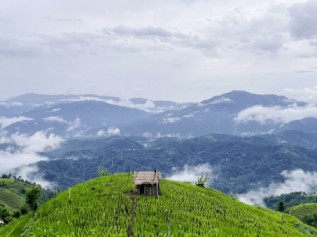
Wokha, home to the world's largest Amur falcon congregation
A forested Naga highland district built around the Doyang Reservoir, where millions of migratory Amur falcons gather each October — paired with Lotha Naga tribal culture, Mount Tiyi, and a frontier-quality travel experience still well below the visibility of Nagaland's better-known circuits.
Landscape & Cultural Context
OverviewWokha sits across forested ridges and valleys in northern Nagaland, defined by the profile of Mount Tiyi, the wide blue surface of the Doyang Reservoir, and dense subtropical forest that stays active with birdlife across the year. The reservoir landscape shifts with the seasons — deep monsoon green through to clear, sharp winter light.
What separates Wokha from other Nagaland districts is not one attraction but the combination: a globally significant wildlife event, a dramatic reservoir landscape, and living Lotha Naga tribal culture, in a destination that still sits well outside the state's more established travel circuits.
The Doyang Reservoir, created by the Doyang Hydroelectric Project, is both the area's most visually commanding feature and the setting for the Amur falcon congregation each October — a natural phenomenon of a scale ornithologists rank among the most extraordinary anywhere on earth.
The Lotha Naga community's warrior heritage, textile traditions and wood carving practice give the destination a cultural depth that stands independently of the migration event, useful for positioning Wokha as a year-round rather than single-window product.
Key Highlights
Within the districtDoyang Reservoir
The district's central landscape feature and the setting for the October Amur falcon congregation — the core product for wildlife-led itineraries.
Mount Tiyi
The district's most prominent peak, culturally significant to the Lotha Naga people and a trekking objective with panoramic reservoir and valley views.
Tsüdikong Lake
A quieter, still-water counterpoint to the reservoir, productive for birdwatching throughout the year.
Lotha Naga Villages
Living tribal culture — textile traditions, wood carving, and community hospitality available through guided village visits.
Kohima Pairing
Approximately 100 km away, allowing Wokha to combine naturally with Kohima's cultural heritage and the Hornbill Festival at Kisama.
Forested Trekking Terrain
Subtropical forest trails across the district, best explored with local Lotha Naga guides for both access and cultural context.
Activities
Programming notesAmur falcon watching at the Doyang Reservoir shore during early morning and evening hours in October is the anchor activity, with the flocks reaching their densest concentrations at these times. Outside the migration window, trekking, birdwatching and Lotha Naga cultural programming carry the destination through the rest of the season.
Connectivity
Routing reference| Mode | Nearest point | Note |
|---|---|---|
| Air | Dimapur Airport | Regular flights from Kolkata, Delhi, Guwahati and Imphal; approx. 75 km from Wokha |
| Road (from Dimapur) | Dimapur → Wokha | Approx. 2–3 hours through the Naga hills |
| Road (from Kohima) | Kohima → Wokha | Approx. 100 km via state and national highway routes |
| Itinerary pairing | Kohima & Kisama | Natural combination with the Hornbill Festival and central Naga hills circuit |
Best Time to Visit
Route planningTwo distinct windows define the Wokha calendar: the Amur falcon migration in October, peaking between the tenth and twenty-fifth of the month, and the extended winter season from November to March offering clear skies and comfortable trekking and cultural touring conditions. Monsoon (June–September) brings heavy rainfall and reduced trail and reservoir-shore access, though the landscape reaches peak green intensity.