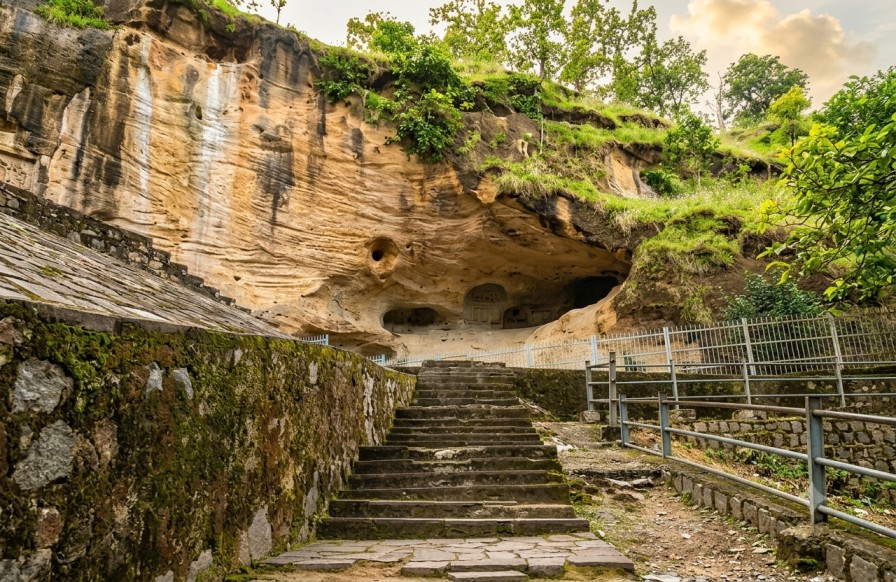
Jogimara & Sitabengra Caves
A twin rock-cut site near Ambikapur dating to the 3rd century BCE, distinguished from India's Buddhist and Jain cave traditions by its entirely secular character — preserving what scholars regard as the oldest known performance theatre and mural paintings in the Indian subcontinent.
One of Central India's most significant rock-cut sites
Jogimara and Sitabengra Caves are counted among the oldest surviving examples of man-made rock architecture in the Indian subcontinent, set on the forested slopes of the Ramgarh Hills. The site offers an early window into the artistic and cultural life of ancient India, drawing historians, archaeologists and heritage travellers to one of the earliest known theatrical spaces anywhere in the world.
What sets the site apart is its departure from the religious character typical of early rock-cut monuments elsewhere in the country. Rather than stupas or deity icons, the caves preserve poetic inscriptions in Brahmi script and the Magadhi language, alongside faded but historically invaluable fresco paintings — a secular tradition of performance and mural art with few parallels of comparable age.
Local legend holds that Rama, Sita and Lakshmana rested in these hills during their exile, giving the Ramgarh hills their alternative name and a further layer of spiritual association. Some traditions also connect the site to the poet Kalidasa, said to have drawn inspiration here for the Meghaduta.
The combination of disputed but well-documented scholarship, mythological resonance and an undisturbed forested setting positions the site as a distinctive addition to heritage and history-focused itineraries across Chhattisgarh.
A rock-cut theatre, and Asia's oldest coloured murals
Sitabengra Cave is recognised by some scholars as possibly the oldest performance theatre on the Indian subcontinent, featuring two tiers of hemispherical rock-cut stone benches facing a partly sculpted, stage-like platform. Interpretations vary — from a venue for poetry recitation and public gathering, to a dharmashala for travellers on an ancient north–south trade corridor.
In the neighbouring Jogimara Cave, fragmented fresco panels — painted originally in three natural pigments and later retouched — depict human figures, animals, birds, dance scenes and geometric patterns, and are considered among the oldest coloured murals in Asia.
Inscriptions across both caves have engaged epigraphists for over a century. The carved lines are widely interpreted as an early literary composition connected to a dancer and an artist associated with the site's creation, lending the location considerable cultural and literary intrigue beyond its architectural interest.
What the site comprises
Sitabengra Cave
Roughly 14 metres in length, with a flat roof and tiered stone benches carved directly into the rock. Its stage-like layout and inscribed walls remain the subject of ongoing scholarly debate over original purpose.
Jogimara Cave
A short distance south of Sitabengra, housing faded ceiling murals arranged in distinct panels separated by coloured bands, alongside a Brahmi inscription regarded as among the earliest surviving pieces of personal, non-religious writing in ancient India.
Hathipol
A long natural rock tunnel formed through centuries of water erosion, wide and tall enough that local tradition compares its passage to an elephant's gate, forming a striking approach to the twin caves.
Ramgarh Hills
The wider hills add scenic and spiritual interest, including the Ram Janaki temple, a seasonal waterfall and a natural forest lake encountered along the trail to the caves.
How visitors engage with the site
Heritage exploration
Examining inscriptions, cave architecture and mural fragments while engaging with the scholarly debate around the site's original purpose.
Forest trekking
A stone-paved trail leads from the base of the hills past a seasonal waterfall and natural lake to the twin caves — a moderate walk suited to most visitors.
Photography & documentation
The rock-cut architecture, faded frescoes and forested surroundings draw history enthusiasts and researchers capturing epigraphic detail.
Regional nature walks
Nearby sites such as Pauri Darwaja and Turrapani allow the archaeological visit to be combined with wider exploration of the forested, hilly landscape.
Seasonal considerations
October – March
Cool, pleasant conditions across the Surguja region make the forested trail comfortable for walking, with temperatures well suited to outdoor exploration and photography.
Summer & Monsoon (June – September)
Rising heat and humidity precede the monsoon, which brings lush greenery but also a slippery stone trail and increased risk of erosion-related damage to the ancient rock surfaces.
Reaching the site
Via NH-130
Approximately 40–45 km from Ambikapur, the Surguja district headquarters, via National Highway 130 and a spur road climbing into the Ramgarh hills, followed by a short marked foot trail.
Ambikapur Station
The nearest railway station, well connected to Bilaspur and Raipur, from where taxis or local transport can be arranged for the onward journey.
Ambikapur & Raipur
Maa Mahamaya Airport, Ambikapur, is nearest; Swami Vivekananda International Airport, Raipur, roughly 295–350 km away, provides broader national connectivity. Public transport to the site itself.
Explore Nearby [Jogimara Sitabengra Caves]