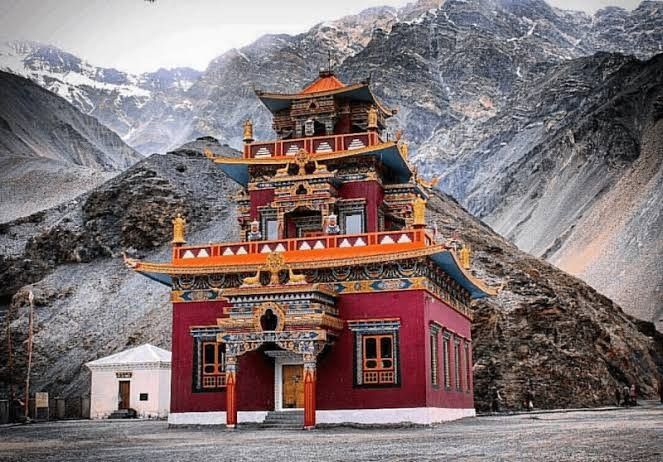
Gue Village
A high-altitude Spiti settlement documented for a single, singular feature: the naturally preserved 15th-century body of the Buddhist monk Sangha Tenzin, held within a purpose-built temple on the edge of the village.
A cold-desert village with one defining landmark
Set in the remote reaches of the Spiti Valley, Gue Village sits among barren mountains, deep valleys, and dramatic rock terrain, distinct from the greener hill stations more commonly associated with Himachal Pradesh. Its profile among travelers rests almost entirely on one discovery: a naturally mummified Buddhist monk, intact for roughly five centuries.
The village draws a cross-section of travelers — history and archaeology audiences, spiritual and Buddhist-heritage circuits, photographers working in high-altitude light, and general Spiti-circuit itineraries adding a short, high-interest stop.
- Subject
- Sangha Tenzin, Buddhist monk
- Era
- Believed 15th century
- Mechanism
- Natural preservation via cold, dry climate — not artificial embalming
- Discovery
- Exposed following a 1975 earthquake
- Current state
- Skin, teeth, hair, and posture intact; housed under glass in a dedicated temple
Natural beauty and landscape character
The surrounding geography is defined by the Spiti cold desert: rugged brown mountains, snow-capped peaks, rocky cliffs, and wide open valleys, with clear skies and sharply changing light across the day. Summer exposes dry terrain patched with cultivated farmland; winter closes the region under snow.
History and cultural significance
Gue's international recognition follows the 1975 earthquake that exposed the preserved remains of Sangha Tenzin, a monk believed to have undergone self-mummification through sustained meditation. Unlike Egyptian mummification practices, the preservation here is attributed entirely to the region's cold, dry climate rather than artificial treatment.
The body is maintained inside a small temple built specifically around it and is treated with active religious respect by the local Buddhist community, not simply displayed as an artifact. The wider village reflects Spiti's Tibetan Buddhist heritage — monasteries, prayer flags, chortens, and mud-brick construction consistent with centuries-old regional custom.
Major attractions and circuit potential
The Mummy Temple remains the core draw, viewed through a protective glass enclosure. The village itself — mud-brick houses, narrow lanes, prayer wheels, cultivated fields — supports a slower, walking-based visit. Gue is well positioned within the broader Spiti circuit:
Adventure and local experiences
Gue functions primarily as a cultural and historical stop rather than an adventure base, but the approach itself is a significant part of the experience: winding mountain roads through deep valleys and remote terrain, well suited to scenic drives, village walks, light hiking, camping, and photography focused on Tibetan architecture, prayer flags, and cultivated terraces.
Wildlife, cuisine, and shopping
Wildlife
High-altitude species adapted to the cold desert, including Himalayan ibex, blue sheep (bharal), Himalayan foxes, marmots, golden eagles, and Himalayan griffon vultures; snow leopards occur in more remote areas.
Cuisine
Homestay-prepared Spitian and Tibetan food: thukpa, momos, tingmo, tsampa, butter tea, skyu, barley-based dishes, yak cheese, and local peas and potatoes.
Shopping
Minimal in Gue itself; most retail activity for the circuit is concentrated in Kaza — Tibetan handicrafts, prayer wheels, woolen garments, pottery, and local organic produce.
Best time to visit and access routes
| Category | Detail |
|---|---|
| Travel window | May to October; roads typically open and conditions favorable. Heavy winter snowfall blocks access outside this window. |
| Nearest airport | Kullu–Manali Airport (Bhuntar); Shimla also serves as a gateway via the Hindustan–Tibet Highway. |
| Nearest railway | Kalka (broad gauge), followed by road travel through Shimla, Reckong Peo, Nako, and Tabo. |
| Road access | Gue Village lies a short distance off the main highway and is accessible directly by road. |
Practical considerations on site
- Layered warm clothing recommended even in summer months
- Gradual acclimatization advised due to high altitude
- No ATM facilities in the village; cash required
- Comfortable walking footwear suited to uneven terrain
- Silence maintained inside the Mummy Temple; no touching displays
- Standard responsible-tourism practices apply, including no littering
Gue Village combines a singular archaeological subject with authentic Spitian culture and cold-desert Himalayan scenery — a compact, high-interest addition to a wider Lahaul & Spiti itinerary rather than a standalone multi-day destination.
Nearby Places to Explore