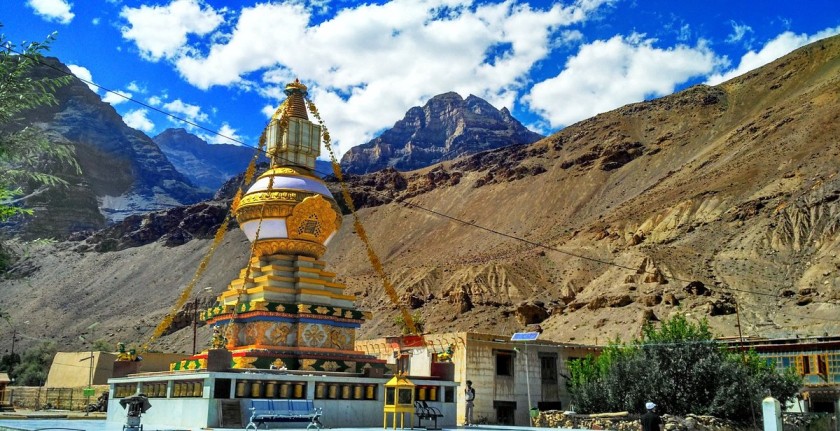
Tabo
Home to Tabo Monastery, founded in 996 CE — one of the oldest continuously functioning Buddhist monasteries in India, known internationally as the "Ajanta of the Himalayas" for its murals, manuscripts, and clay sculpture.
The spiritual centre of Spiti Valley
Tabo sits in the Spiti Valley beside the Spiti River, surrounded by barren mountains and cultivated barley, pea, and potato fields. Its significance rests on more than a thousand years of uninterrupted monastic tradition, making it one of India's most historically important Buddhist sites.
The village draws pilgrims, Buddhist heritage circuits, art and manuscript researchers, photographers, and general Spiti-circuit travelers for whom Tabo is treated as an essential, non-optional stop.
- Founded
- 996 CE
- Founder
- Rinchen Zangpo, Buddhist scholar
- Patronage
- Kingdom of Guge
- Known as
- "Ajanta of the Himalayas"
- Notable for
- Murals, clay sculpture, ancient manuscripts
Natural beauty and landscape character
Towering barren mountains, rugged cliffs, and wide river valleys surround Tabo, with the Spiti River running alongside fertile green patches set against brown and grey rock. Summer brings cultivated barley, pea, and potato fields; winter covers the valley in snow. Sunrise and sunset light across the surrounding peaks is a recurring reference point for photography-led visits.
History and cultural significance
Tabo Monastery was founded in 996 CE by the Buddhist scholar Rinchen Zangpo under the patronage of the Kingdom of Guge, giving it more than a thousand years of continuous spiritual use. Its murals, ancient manuscripts, and clay sculpture have drawn comparison to the Ajanta Caves, earning it the informal title "Ajanta of the Himalayas."
The site remains an active center for Buddhist learning and meditation rather than a preserved-only monument, with traditional Tibetan Buddhist festivals and rituals continuing in the present day.
Major attractions and circuit potential
Tabo Monastery itself comprises multiple temples, meditation halls, stupas, and monks' quarters. Nearby, the Tabo Meditation Caves on the adjacent hillside have been used for centuries of monastic practice overlooking the valley. Tabo also connects directly into the wider Spiti circuit:
Adventure and outdoor experiences
Beyond its spiritual role, Tabo supports trekking, hiking, mountain biking, scenic road trips, camping, and village walks through the surrounding terrain. Several trekking routes connect Tabo to nearby monasteries, villages, and high-altitude passes. The setting also lends itself to meditation retreats and mindfulness-focused stays, alongside photography of the monastery's mud-brick architecture and the valley's changing light.
Wildlife, cuisine, and shopping
Wildlife
Himalayan ibex, blue sheep (bharal), red foxes, Himalayan wolves, marmots, golden eagles, and Himalayan griffon vultures; snow leopards occur in more remote areas.
Cuisine
Local cafés and homestays serve thukpa, momos, tingmo, butter tea, skyu, tsampa, barley-based meals, yak cheese, local peas and potatoes, and traditional Himalayan breads.
Shopping
Modest local options — prayer flags, prayer wheels, woolen garments, handicrafts, and handcrafted jewelry — with larger selection available in nearby Kaza.
Best time to visit and access routes
| Category | Detail |
|---|---|
| Travel window | May to October; roads open and conditions favorable. Winter brings heavy snowfall and extreme cold, making travel more difficult. |
| Nearest airport | Kullu–Manali Airport (Bhuntar); Shimla Airport (Jubbarhatti) also serves travelers via the Shimla route. |
| Nearest railway | Kalka (major station), followed by road travel through Shimla, Reckong Peo, Nako, and Sumdo to Tabo. |
| Local transport | Regular buses and taxis connect Tabo with Kaza, Reckong Peo, and other towns during the tourist season. |
Practical considerations on site
- Layered warm clothing year-round; temperatures stay cool throughout
- Acclimatization time recommended given the altitude
- Modest dress and silence expected inside the monastery
- Permission required before photographing restricted areas
- Cash advised; ATM facilities are limited
- Homestays and handmade-product purchases support the local economy
Tabo pairs a thousand-year, still-active monastic tradition with the physical drama of the Spiti cold desert — a heritage-anchor stop that most Spiti Valley itineraries treat as non-negotiable.
Nearby Destination and Attraction
- sumdo : Where The Journey To Spiti Begins
- Gue-Village : Where Time Stands Still
- Spiti-Valley : Cold Desert Of Himachal Pradesh
-
Pin-Valley-National-Park : The Wild Heart Of Spiti
- kunzum Pass : The Gateway To Spiti Valley