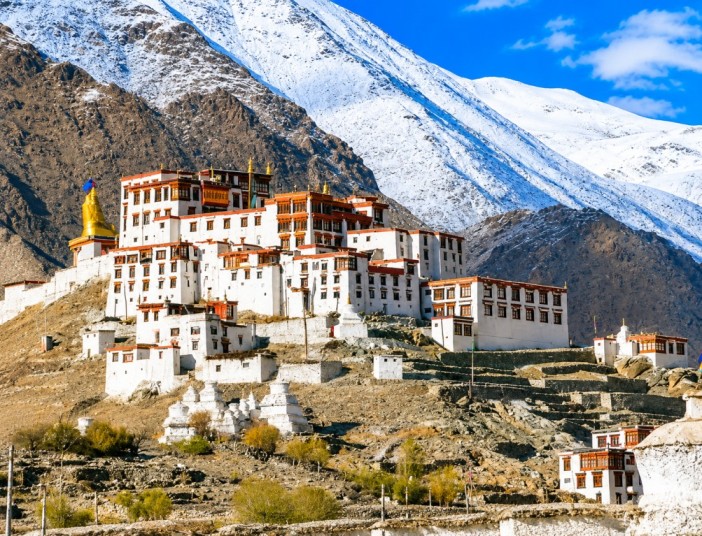
Sumdo
A river-side village along the Spiti River that functions as the official Kinnaur-side gateway into Spiti Valley — the point where permit formalities are completed before travelers continue toward Tabo and Kaza.
A gateway village on the Spiti River
Sumdo sits along the banks of the Spiti River in the remote Lahaul and Spiti district, surrounded by rugged mountains, deep gorges, and cold desert terrain. Though frequently treated as a transit point, it offers a genuine view into Spitian village life and dramatic Himalayan scenery in its own right.
The village draws road-trip travelers, photographers, solo and nature-focused travelers, and families passing through en route to the wider Spiti circuit, as well as adventure travelers using it as a staging point for onward routes.
- Route role
- Kinnaur-side entry point to Spiti Valley
- Formalities
- Permit processing typically completed here
- River
- Positioned directly on the Spiti River
- Historic role
- Former stop on the Kinnaur–Spiti–Tibet trade route
- Onward route
- Continues toward Tabo and Kaza
Natural beauty and landscape character
Towering barren mountains, rocky cliffs, and winding river valleys define the setting, with the Spiti River cutting through deep, rocky terrain below clear skies. Summer brings patches of green farmland against brown mountain slopes; winter covers the region in snow. Shifting light at sunrise and sunset is a particular draw for landscape photography.
History and cultural significance
Sumdo's historical role predates modern tourism: it sat on the trade route linking Kinnaur, Spiti, and Tibet, used by traders moving wool, salt, and grain through the high Himalaya. That transit function continues today in a different form, as the village is the recognized entry checkpoint into Spiti Valley from the Shimla–Kinnaur route.
Tibetan Buddhist influence is visible in nearby monasteries, prayer flags, chortens, and traditional mud-brick construction, consistent with the broader cultural character of the Spiti region.
Major attractions and circuit potential
Sumdo's own draw is the quiet village, riverside walks along the Spiti River, and open Himalayan views. Its greater value lies in its position as the entry point to a dense cluster of Spiti Valley destinations:
Adventure and outdoor experiences
The surrounding terrain supports scenic road trips, trekking, mountain biking, camping, and photography, with Sumdo often used as a starting point for nearby trekking routes and high-altitude villages. Winding mountain roads make the approach itself a notable driving and motorcycling route, and photographers can work with the river, prayer flags, monasteries, and traditional village architecture.
Wildlife, cuisine, and shopping
Wildlife
Cold desert species including Himalayan ibex, blue sheep (bharal), Himalayan foxes, marmots, golden eagles, and Himalayan griffon vultures; snow leopards occur in more remote areas.
Cuisine
Homestay and guesthouse-prepared Spitian and Tibetan food: thukpa, momos, tingmo, butter tea, tsampa, skyu, barley dishes, yak cheese, and local peas and potatoes.
Shopping
Limited directly in Sumdo given its size; most travelers shop in Kaza for Tibetan handicrafts, prayer flags, woolen garments, pottery, and organic produce.
Best time to visit and access routes
| Category | Detail |
|---|---|
| Travel window | May to October; roads generally open and conditions favorable. Heavy winter snowfall can restrict access outside this window. |
| Nearest airport | Kullu–Manali Airport (Bhuntar); Shimla Airport (Jubbarhatti) also serves travelers approaching via the Shimla route. |
| Nearest railway | Kalka (major station), followed by road travel through Shimla, Reckong Peo, and Nako to Sumdo. |
| Local transport | Regular buses, shared taxis, and private vehicles connect Sumdo with major Spiti towns during the tourist season. |
Practical considerations on site
- Layered warm clothing year-round; temperatures shift rapidly at altitude
- Acclimatization time recommended before continuing deeper into Spiti
- Carry cash, drinking water, basic medicines, sunscreen, and power banks
- Facilities in the village are limited
- Local customs and wildlife should be respected and undisturbed
- Homestay stays and reduced plastic use support sustainable tourism
Sumdo functions as both checkpoint and destination — a river-side gateway with genuine Spitian village character, positioned at the start of one of the most consistently requested circuits in Himachal Pradesh.
Discover Nearby Attractions