Har Ki Doon
Valley
The Valley Where Heaven Begins
A pristine glacial amphitheatre at 3,566 m, set within the Govind Pashu Vihar National Park. One of the Garhwal Himalaya's most coveted trekking routes — now available for your international programme. Exclusive trade resources, itinerary briefs, and a dedicated partnership desk for inbound tour operators.
Why Add Har Ki Doon to Your Portfolio
This destination is underrepresented on the international inbound circuit — offering differentiated product for operators seeking authentic Himalayan experiences that go beyond the standard Rishikesh or Manali circuit.
Uncrowded, High-Yield Terrain
Unlike Kedarnath or Valley of Flowers, Har Ki Doon remains lightly trafficked — giving your clients genuine Himalayan solitude and your agency a differentiated premium offering.
UNESCO-Class Living Heritage
Ancient Kath-Kuni wooden architecture and the rare Duryodhana Temple of Osla village deliver a cultural depth layer that enriches any nature-based Himalayan programme.
Protected Wildlife Corridor
Set within a national park hosting snow leopard, Himalayan brown bear, musk deer, and the western tragopan — delivering strong appeal to eco-conscious and wildlife-focused travellers.
Dual Peak Season Windows
May–June and September–November operating windows allow year-round portfolio placement with clear seasonal differentiation for spring wildflower or autumn clarity itineraries.
Established Ground Support
Reliable local guide networks from Tons valley communities, accommodation at Sankri roadhead, and equipment hire infrastructure — reducing your operational risk on the ground.
Gateway Airport Connection
Jolly Grant Airport (Dehradun) handles regular domestic connections from Delhi, Mumbai, and major Indian hubs — enabling seamless international-to-domestic transfer itineraries.
A Glacial Valley of Exceptional Depth
Har Ki Doon stands as one of the most scenically magnificent and culturally extraordinary destinations in the Indian Himalayan region — a cradle-shaped glacial valley of rare natural beauty nestled deep within the Garhwal Himalayas, where ancient villages, dense oak and rhododendron forests, alpine meadows, and snow-crowned peaks of dramatic grandeur converge.
Situated in the Uttarkashi district of Uttarakhand within the Govind Pashu Vihar National Park and Sanctuary, the valley is accessible only on foot through a multi-day journey through the Tons River valley and its tributaries — a quality of remoteness that underpins its value as a high-exclusivity experience.
The destination's singular distinction lies in its combination of a living village culture of extraordinary antiquity, embedded within a high-altitude natural landscape of exceptional biodiversity, and underpinned by mythological resonance of the deepest kind — the valley is believed in local tradition to be the route taken by the Pandavas on their final journey heavenward as described in the Mahabharata.
This layered character elevates Har Ki Doon beyond a simple trekking destination into a landscape of natural sanctity, cultural depth, and Himalayan grandeur that your most discerning clients will find profoundly rewarding.
Landmark Experiences for Your Clients
Every element below is a programmable highlight — suitable for inclusion in itinerary briefs, brochure copy, or client pre-departure documentation.
The Har Ki Doon Glacial Amphitheatre
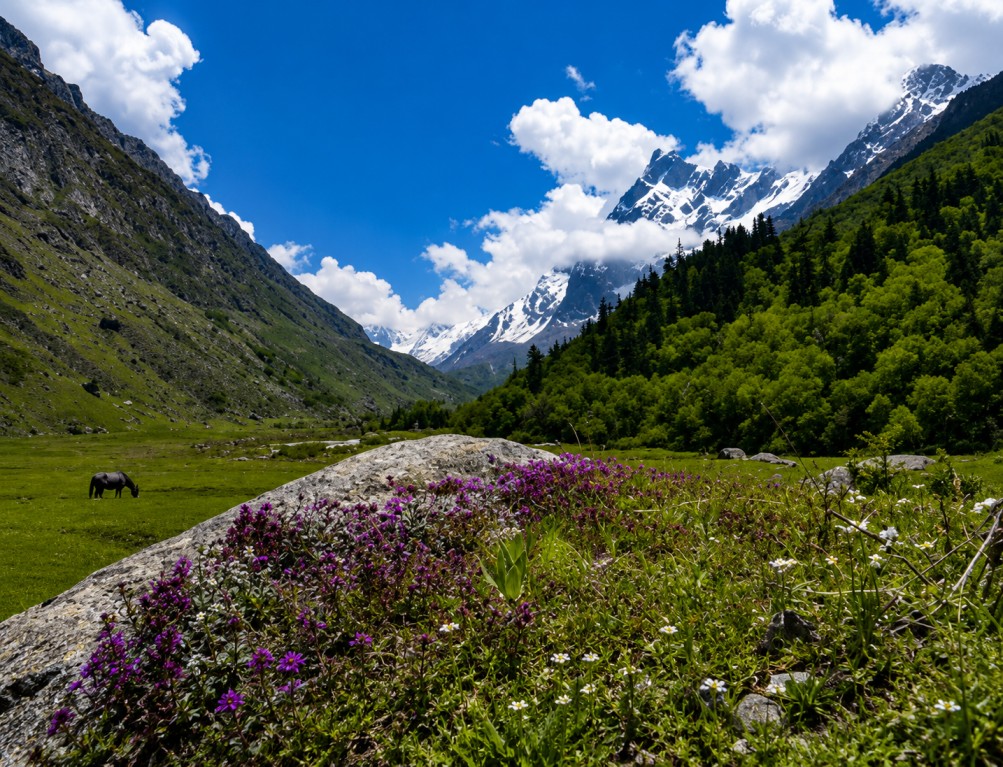
The iconic valley head, enclosed on three sides by the Swargarohini massif, Hata Peak, and connecting ridgelines. The broad alpine meadow floor beneath a skyline of Himalayan snow and rock is the defining visual experience of the destination — comparable to any alpine valley in the European or Central Asian circuits.
Osla Village & Duryodhana Temple
One of the most culturally remarkable village encounters available on any Indian Himalayan trek. The multi-storeyed Kath-Kuni wooden houses and the rare Duryodhana Temple — one of only a handful dedicated to the Kaurava prince in all of India — offer your clients a living heritage encounter of international significance.
Swargarohini Massif
Meaning "Stairway to Heaven," the Swargarohini peak dominates the valley head with a presence of both visual magnificence and mythological resonance — associated in local tradition with the Pandavas' final ascent. One of the most emotionally compelling mountain summits visible from any trekking valley in Uttarakhand.
Rhododendron & Oak Forest Approach
The lower Tons valley approach passes through dense forests of oak, rhododendron, horse chestnut, and Himalayan birch — particularly spectacular in the spring months when rhododendrons bloom in vivid red and pink above the rushing Tons River, providing a natural spectacle ideal for photography-focused groups.
Jaundhar Glacier & Morinda Tal
Optional extension objectives for longer programmes: the Jaundhar Glacier at the valley head and Morinda Tal alpine lake on the southern ridge offer progressively more demanding excursions into the high-altitude glacial landscape — suitable for experienced trekking groups seeking extended itineraries.
Snow Leopard Country
The protected landscape of the Govind Pashu Vihar supports snow leopard, Himalayan brown bear, musk deer, and the endangered western tragopan pheasant — creating genuine wildlife encounter possibilities for nature-focused programmes and providing compelling pre-departure narrative for international travellers.
What You Can Build Into Your Itinerary
The following activities form the building blocks of a complete Har Ki Doon programme, from core trekking to specialist extensions suitable for wildlife, photography, or cultural focus groups.
Multi-Day Guided Trek: Sankri to Har Ki Doon
The core programme: approximately 40 km from the Sankri roadhead across 3–4 days of walking through the Tons gorge, forested middle sections via Taluka and Seema, and final ascent to the valley floor. A journey of successive scenic escalation, suitable for FIT groups and guided small-group departures. Local certified guides and porters available through established valley networks.
Side Valley & Glacier Exploration
Extended high-altitude excursions from the valley base camp to the Jaundhar Glacier, Morinda Tal alpine lake, and the Ruinsara Tal approach — each offering progressively more demanding but exceptionally scenic terrain. Ideal for longer programmes of 7–10 days and experienced trekking clientele seeking summit views and glacier environments.
Birdwatching Programme
The Govind Pashu Vihar supports an outstanding diversity of Himalayan avifauna including Himalayan monal, koklass pheasant, lammergeier, golden eagle, and numerous species of rosefinch, accentor, and warbler across successive elevation zones. A dedicated birdwatching programme can be layered onto the standard trek for specialist groups or as a feature of a nature-focus departure.
Cultural Village Encounter — Osla
A guided cultural immersion in Osla village — meeting local families, exploring the Kath-Kuni architecture, visiting the Duryodhana Temple with local interpretation, and learning about the Mahabharata traditions that shape community identity. A uniquely compelling cultural component for heritage-focused itineraries or travellers seeking living-culture encounters beyond the standard tourist circuit.
Alpine Flora Documentation (May–June)
The valley meadows carpet with primula, brahmakamal, and numerous endemic wildflower species during the summer months, making May–June a particularly rewarding period for botanically-inclined travellers and photography groups. This seasonal specialisation provides a strong differentiating angle for spring departures marketed to European and North American nature-travel audiences.
Operating Windows & Season Selection
Use the guide below for departure scheduling and marketing angle selection. Two distinct seasons offer complementary natural characters suited to different client profiles.
Spring: Wildflower Season
Rhododendron bloom in the lower forests. Alpine wildflowers carpet the valley floor. Fresh seasonal greenery on approach. Snowpack still visible on peaks for dramatic visual contrast. Ideal for botanical, photography, and first-time Himalayan trekking groups.
Monsoon: Trail Restricted
Heavy rainfall across the Garhwal Himalaya renders the Tons valley trail slippery and subject to landslip. Trek access significantly impaired. Not recommended for programme scheduling. Operators should exclude this window from departure calendars.
Autumn: Peak Clarity Season
Clearest skies and most stable weather of the operating year. Sharpest mountain views with post-monsoon clarity. Golden Himalayan light ideal for photography. Widely regarded by experienced Himalayan trekkers as the finest visual season. Best for photography tours, luxury small-group, and repeat traveller programmes.
Winter: Route Closed
Deep snowfall to the valley and its approach closes the trek route entirely until the spring thaw. No programmatic activity possible. Winter mountaineering expeditions by specialist arrangement only — contact the trade desk for bespoke enquiries.
Getting Your Clients To the Trailhead
The Har Ki Doon approach is well-served by the Dehradun gateway. Below is the connectivity infrastructure to integrate into your transfer and pre/post tour documentation.
✈ Air Gateway
Jolly Grant Airport (DED), Dehradun — served by regular domestic connections from:
- Delhi (IGI) — multiple daily services
- Mumbai — daily connections
- Other major Indian hubs via IndiGo, Air India, SpiceJet
International clients route via Delhi IGI, then connect to DED for same-day arrival in Dehradun.
🚂 Rail Access
Two established railheads for road transfer to Sankri:
- Dehradun Railway Station — direct services from Delhi, Mumbai, Kolkata
- Haridwar Junction — broader network connectivity; 1 hr transfer to Dehradun
Preferred for budget group travel or clients combining with a Rishikesh extension.
🚗 Road Transfer
- Dehradun → Sankri: ~200 km via Tons River valley road through Purola and Mori
- Transfer duration: 8–9 hours through mountain terrain
- Overnight at Sankri recommended before trek commencement
🏕 Roadhead Facilities (Sankri)
- Guesthouses and basic lodges available for pre-trek night
- Equipment hire including sleeping bags, trekking poles, tents
- Licensed local guide and porter registration
- Vehicle parking and group assembly point
- Basic ration and provision procurement