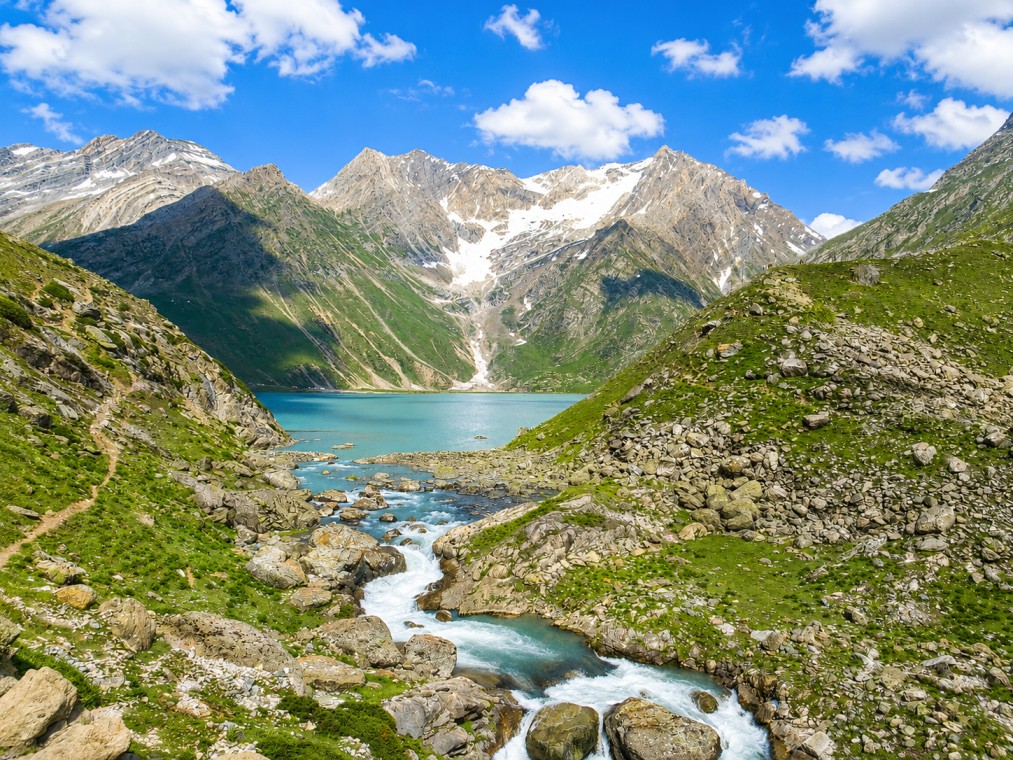
🏔️ Sheshnag Lake, Kashmir: The Sacred Alpine Mirror at the Roof of the Lidder Valley
A High-Altitude Lake Where Mythology Meets the Himalayas
🌄 Overview
At 3,590 metres above sea level, in the Anantnag district of Kashmir's Jammu & Kashmir union territory, Sheshnag Lake sits in a bowl of cold sky and silence. (Also spelled Sheshang or Sheshnag — all refer to the same lake, named from the Kashmiri Shishinag.) On three sides, snow-capped ridges rise steeply from its shores. Below, the waters are an improbable shade of deep blue-grey — crystalline, still, almost metallic in the right light. Stretching 1.1 kilometres in length and around 700 metres wide, it is not a large lake, but it carries a weight entirely out of proportion to its size: geological, spiritual, and visual.
This is one of the most beautiful high-altitude lakes in India, and it remains less visited than it deserves to be — in part because reaching it requires a trek, and in part because most travellers who come here arrive as pilgrims en route to the Amarnath Cave, roughly 25 kilometres further up the same trail. For those who come simply for the lake itself, the reward is a place of rare stillness that most alpine destinations in the world cannot match.
🐍 The Mythology Behind the Name
The name comes directly from Hindu cosmology. Sheshnag (Śeṣanāga) is the nagaraja — the King of all Nagas, the many-headed serpent deity upon whose coils Lord Vishnu reclines in eternal rest. According to legend, Sheshnag himself created this lake and dwells within it; the deep cloudbursts of ancient times carved a gorge into the mountain, and the snowmelt slowly filled it into the lake that exists today.
The folklore connection is older still. A famous Kashmiri folk tale — Himal and Nagrai — involves a spring near Srinagar connected to the Naga, the serpent king. A stone marker there still commemorates the story, tracing the original mythic inhabitants of the Kashmir Valley. When Hindu pilgrims undertaking the Amarnath Yatra pause at Sheshnag Lake, they are not merely resting — they are performing a devotional act at a site that has carried sacred meaning for many centuries.
```html
🥾 The Trek: Three Sections, One Spectacular Destination
The standard approach begins at Chandanwari (around 3,895 metres), roughly 16 kilometres from Pahalgam by road, and itself 23 kilometres from the lake on foot. The trail breaks into three distinct sections:
🌲 Chandanwari to Pissu Top
An initially gradual ascent along the Lidder River through maple and pine forest. Pissu Top opens up the entire Lidder Valley below you in a single, sweeping panorama — one of the finest viewpoints on any Kashmir trek.
🌿 Pissu Top to Jojibal
The descent through a narrow valley flanked by high ridges, past undulating grassland meadows where Gujjar shepherds graze their flocks seasonally. Their temporary huts dot the hillside; a brief conversation, if they're around, is one of those genuinely unrepeatable travel encounters.
🏞️ Jojibal to Sheshnag Lake (Kutta Ghati)
The final 2.2 kilometres along a narrow path called Kutta Ghati. This is the section where the mountain walls close in and the lake suddenly appears below — a moment that tends to stop people mid-step.
The full trek is classified easy to moderate. The Pissu Top ascent is steep and requires care (the trail is slippery), but the rest is manageable for anyone with reasonable fitness. Most trekkers complete it in 5–7 hours return from Chandanwari, or camp overnight at the lake.
💎 The Lake Itself: What You'll Find
Sheshnag Lake is an oligotrophic lake — low in nutrients, high in oxygen — which is why its waters are so exceptionally clear and why brown trout thrive here. (Trout fishing is possible with a permit and adds a quiet, unhurried dimension to a longer stay.) The lake freezes solid in winter and is completely inaccessible from November to May due to heavy snowfall. In summer, the banks are lined with wildflowers — primulas, anemones, and alpine forget-me-nots — against a backdrop of permanent snowfields above.
Wildlife in the broader region includes Himalayan black bear, Himalayan brown bear, leopard, and jackal — nomads and shepherds have spotted all of these on the trail. Trek in a group of at least three to four people, and don't approach Gujjar shepherd huts uninvited (their guard dogs are formidable). The presence of shepherds and the Amarnath Yatra infrastructure along parts of the trail means you are rarely entirely alone, which is reassuring for less experienced high-altitude trekkers.
👣 Who Sheshnag Lake Is For
Pilgrims and spiritual travellers will find this a genuinely sacred pause on the Amarnath route — a place to rest, reflect, and feel the weight of the landscape. Trekkers and adventure enthusiasts get an accessible alpine lake that punches well above its technical difficulty in terms of scenery. Photographers have outstanding material in every direction: the lake surface mirroring the peaks, the wildflower meadows at Jojibal, the long Lidder Valley views from Pissu Top, and the drama of the Kutta Ghati approach. Nature lovers will appreciate the rare ecological character of an oligotrophic Himalayan lake and the density of alpine flora in season. Couples and solo travellers looking for something quieter than the Kashmir tourist circuit — beyond the houseboats and Pahalgam pony rides — will find Sheshnag deeply satisfying. Families should be aware of the altitude and distance; the trek is not suitable for young children.
📅 Best Time to Visit
June to early October is the window. July and August are peak season, coinciding with the Amarnath Yatra, which means the trail is more populated and tent camps are operational at the lake shore. June offers the freshest wildflowers and the least crowded experience. September brings crisp autumn clarity and the Yatra crowds have thinned. Avoid October onwards — snowfall can close the trail without warning. The lake is completely inaccessible from November through May.
Summer daytime temperatures at the lake hover between 10–18°C; nights drop to near or below freezing. Carry layers regardless of how warm the morning feels in Pahalgam.
``` ```html
🚗 How to Get There
🛣️ Srinagar to Pahalgam
~96 km by road, approximately 2.5–3 hours by taxi or cab
🚙 Pahalgam to Chandanwari
~16 km by road, 30–40 minutes by jeep/shared taxi
🥾 Chandanwari to Sheshnag Lake
23 km on foot, 5–7 hours trekking
The nearest airport is Sheikh ul-Alam International Airport, Srinagar (~120 km from the lake). Most trekkers stay in Pahalgam the night before and arrange transport to Chandanwari early morning.
🧳 Practical Tips
📄 Permits
Obtain a trek permit from the Pahalgam Development Authority before departing. During the Amarnath Yatra period (June–August), additional registration may be required along the shared trail.
🐎 Ponies
Available for hire at Chandanwari if you prefer not to carry your pack. Regulated by J&K Tourism; maximum load 40 kg per animal.
⛺ Camping
Tent camps operate at the lake during summer, with basic meals and sleeping arrangements. Book through Pahalgam-based operators.
💧 Water
Fill bottles at Jojibal from the Lidder River — the water is clean at this point. The lake itself is of drinking quality but treat it before consuming.
🏔️ Altitude
Acclimatise in Pahalgam (2,130 metres) for at least one night before trekking. Symptoms of AMS (headache, nausea, dizziness) should never be ignored at altitude.
🥾 Trekking Shoes
Non-negotiable. The Pissu Top section and Kutta Ghati are genuinely slippery on wet rock.
🌦️ Weather
Changes rapidly and without warning above 3,000 metres. Carry a waterproof layer in your pack at all times.
✨ The Bottom Line
Sheshnag Lake rewards effort honestly and proportionately. The climb is real, the distance is real, and the cold is real — but so is the lake, shining still and blue in its mountain bowl, exactly where the legend said it would be.
Nearby Places To Visit
- Chandanwari
- Betaab Valley