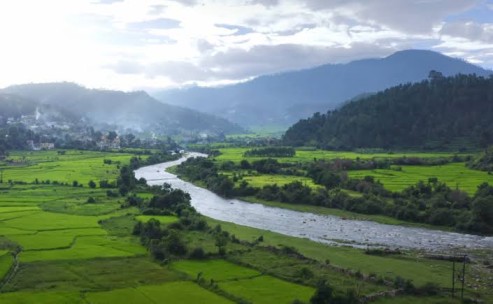
A working valley of orchards, terraces and temple stone
Someshwar Valley sits along the Kosi River at 1,100–1,300 m, a lesser-known counterpart to Kausani and Almora built on fruit cultivation, Kumaoni village life and the Someshwar Mahadev Temple — a low-density alternative for itineraries that already cover the Kumaon circuit.
Geography and landscape
Terraced farmland, pine forest and orchard cover define the valley floor, with the Kosi River running through it and Himalayan sightlines available above the tree line.
Cultivation
Orchards of apple, apricot, peach and plum sit alongside terraced rice, wheat and vegetable plots — the valley's economy is agricultural first, tourism second.
Watercourse
The Kosi River threads the valley floor, shaping riverside walking routes and picnic ground and feeding the surrounding terrace irrigation.
Sightlines
On clear days, distant views extend to Nanda Devi, Trishul and Nanda Kot — best from higher terrace edges in winter and post-monsoon months.
Cultural and religious context
The valley takes its name from the Someshwar Mahadev Temple, a Shiva shrine that anchors the area's identity and continues to draw regional devotion.
Someshwar Mahadev Temple
The valley's principal landmark and namesake, set within quiet natural surroundings — relevant for itineraries built around Kumaoni temple architecture and living devotional practice rather than staged heritage sites.
Village life
Kumaoni architecture, terrace farming, folk music and household hospitality remain part of daily life rather than a curated display, which shapes what a village-tourism product here can and cannot promise.
Seasonality
Three distinct windows suit different product types — orchard bloom, clear-sky viewing, and quiet winter travel.
Product themes
What the valley currently supports, drawn directly from what's on the ground rather than aspirational positioning.
Soft adventure
Forest-trail trekking at easy-to-moderate grade, cycling on quiet mountain roads, birdwatching, and designated-area camping.
Rural and village tourism
Orchard walks, terraced-field photography, and visits into Kumaoni villages for a look at working farm life rather than a re-creation of it.
Wildlife and birding
Forest cover supports barking deer, Himalayan langur, occasional leopard sightings in remote tracts, fox, Himalayan black bear, pheasant and a range of resident birds.
Culinary interest
Kumaoni dishes including Bhatt Ki Churkani, Kafuli, Chainsoo, Aloo Ke Gutke, Mandua Roti, Jhangora Ki Kheer, Bal Mithai and Singori, largely built on local, organic produce.
Craft and local goods
Almora and surrounding markets carry Kumaoni shawls, woollens, copperware, wooden handicrafts, herbal products, local honey and fruit preserves.
Circuit positioning
Sits within reach of Kausani, Baijnath Temple, Almora, Binsar Wildlife Sanctuary, Katarmal Sun Temple and Ranikhet — usable as a stop rather than a standalone base.
Access and routing
Road-dependent access from two transport hubs; no direct rail or air link into the valley itself.
| Gateway | Distance / Note | Onward journey |
|---|---|---|
| Pantnagar Airport | Approx. 130 km | By road, typically routed via Almora or Kausani |
| Kathgodam Railway Station | Nearest railhead | Well connected to major Indian cities; onward by taxi or bus |
| Almora / Kausani | Regional hub towns | Regular taxi and bus services link both towns to the valley |
Notes for itinerary planning
Practical points relevant to routing and guest briefing.
- Pace: The valley reads as a slow, low-density stop — better suited to a 1–2 night inclusion within a wider Kumaon itinerary than a standalone destination.
- Footwear and layering: Village and trail walks call for comfortable walking shoes; light woollens year-round, heavier layers in winter.
- Temple etiquette: Local customs apply at the Someshwar Mahadev Temple and other shrines; brief guests accordingly.
- Local sourcing: Handmade goods and produce are largely small-batch and village-sourced — useful context for guests interested in provenance.
- Environmental load: Terrace farmland and forest cover are working land, not managed parkland; standard low-impact practices apply.
Nearby Places To Explore
- Kausani - Where The Hmalayas Embrace Serenity
- Rudradhari-Falls : Where Nature Meets Divinity
- Binsar-Wildlife-Sanctuary : A Hidden Himalayan Paradise