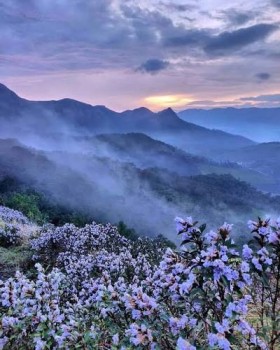
🌸 Neelakurinji, Kerala — When the Hills Turn Blue and Time Stands Still
Imagine standing on a hillside in Kerala, surrounded by rolling western ghats as far as the eye can see — and instead of the usual green, the entire landscape has turned a deep, dreamy shade of violet-blue. Not a painting, not a dream, but the real, living, blooming miracle of Neelakurinji (Strobilanthes kunthiana) in full flower. This is one of nature's most extraordinary spectacles, a phenomenon so rare and so breathtaking that people plan journeys years in advance just to witness it. And when it finally arrives, it does not disappoint.
Neelakurinji isn't a place you visit every year. It isn't even a place you visit every decade. This remarkable flowering shrub blooms only once every twelve years, carpeting the shola grasslands of the Western Ghats — particularly the misty hills of Munnar, Eravikulam, and the Nilgiri ranges of Kerala — in a violet-blue sea that stretches across entire mountain slopes. The word itself tells you everything: neela means blue, and kurinji is the flower. Together, they give the Nilgiris — the Blue Mountains — their very name.
📜 A Little Bit of History First
The Neelakurinji has been flowering across these hills long before humans gave it a name, and the indigenous Muthuvan and Kadar tribal communities of the Western Ghats have lived in quiet intimacy with this cycle for generations. For them, the blooming of the Kurinji was not a tourist event but a marker of time itself — a living calendar written in flowers.
The broader world began to pay serious attention during the colonial era, when British botanists and hill station residents marvelled at the periodic transformation of the Munnar hillsides. Over time, ecologists and conservationists recognized the Neelakurinji as a keystone species of the shola grassland ecosystem, and the Eravikulam National Park near Munnar was established in 1978 to protect the grasslands where this extraordinary plant thrives. The last major bloom in 2018 drew lakhs of visitors to Munnar, turning the hillsides into a pilgrimage of wonder for nature lovers across India and the world. The next bloom is expected around 2030 — and the anticipation is already building.
🌄 The Experience That Will Leave You Speechless
When the Neelakurinji is in bloom, the entire character of Munnar and the surrounding Eravikulam highlands transforms completely. Walking through the Eravikulam National Park, you are surrounded by undulating hills blanketed in violet-blue flowers that extend to every horizon, broken only by granite outcrops, mist-laden valleys, and the occasional silhouette of the endangered Nilgiri Tahr moving through the bloom.
The Top Station viewpoint near Munnar offers perhaps the most panoramic perspective of the Neelakurinji bloom, with sweeping views across the Tamil Nadu border where the blue hills roll endlessly into the distance. Rajamala, within Eravikulam National Park, is the most accessible and ecologically rich zone for experiencing the flowering, and the gentle walking trails here allow visitors to move through the bloom at their own pace, camera in hand, hearts full.
Beyond the bloom season, the shola grasslands of this region remain hauntingly beautiful — mist-wrapped, ecologically extraordinary, and home to rare wildlife including the Nilgiri Tahr, the Indian giant squirrel, and a stunning variety of endemic birds. The grasslands and shola forests represent one of the most biodiverse and endangered ecosystems in all of Asia.
👣 Culture, People, and the Spirit of the Hills
The Neelakurinji experience is inseparable from the human communities that share these hills. The Muthuvan tribal community, whose ancestral lands span the Munnar highlands, carry generations of ecological knowledge about the Western Ghats and their extraordinary biodiversity. Many tribal-led ecotourism initiatives around Munnar offer visitors meaningful and respectful opportunities to learn about indigenous relationships with the forest, the flowers, and the highland way of life.
Munnar town itself, just a short drive from the bloom zones, pulses with the warm, easy charm of a Kerala hill community. Sip freshly brewed single-estate tea at a local plantation café, pick up handmade spices, and savour Kerala sadya — the traditional feast served on banana leaf — at one of the family-run restaurants that line the town's main road. The combination of tribal heritage, plantation culture, and Kerala hospitality gives this entire region a richness that extends far beyond any single natural spectacle.
📅 Best Time to Visit
If you are planning to witness the Neelakurinji bloom, the window arrives once every twelve years, typically between August and October during the bloom year. The 2018 bloom peaked in August and September, and the next bloom around 2030 is expected to follow a similar pattern. Outside bloom years, the best time to visit the Munnar and Eravikulam region is from September to March, when skies are clearest, temperatures are cool and comfortable, and the Nilgiri Tahr and other wildlife are most active and visible. Monsoon months from June to August bring dramatic mist and lush greenery, though some trekking areas may be closed.
🚗 How to Get There
By Air: The nearest airport is Cochin International Airport (COK), approximately 130 kilometres from Munnar. It is well-connected to major Indian cities and international destinations. From Cochin, taxis and KSRTC buses cover the winding drive to Munnar in roughly four hours.
By Rail: The nearest railway station is Ernakulam (Kochi), from where regular bus and taxi services run to Munnar. The road journey through the ghats is itself a scenic experience worth savouring slowly.
By Road: Munnar is well connected by road from Kochi, Coimbatore, Madurai, and Thekkady. Kerala State Road Transport Corporation (KSRTC) operates regular services, and private taxis are widely available for a more comfortable journey up the beautiful ghat roads.
✨ Why You Simply Must Witness Neelakurinji
Some things in this world happen quietly, on their own schedule, entirely indifferent to human plans — and they are all the more magnificent for it. The Neelakurinji does not bloom for tourists. It does not bloom for cameras or social media. It blooms because it has always bloomed, on a cycle older than memory, painting these ancient hills blue the way they were meant to be painted.
To stand in the middle of a Neelakurinji bloom is to feel, perhaps for the first time, what it means to be a guest in nature's home rather than its master. Pack your bags early — very early — and let the blue hills of Kerala remind you that the most extraordinary things in life are always, always worth the wait.
Discover More Around [Neelakurinji]