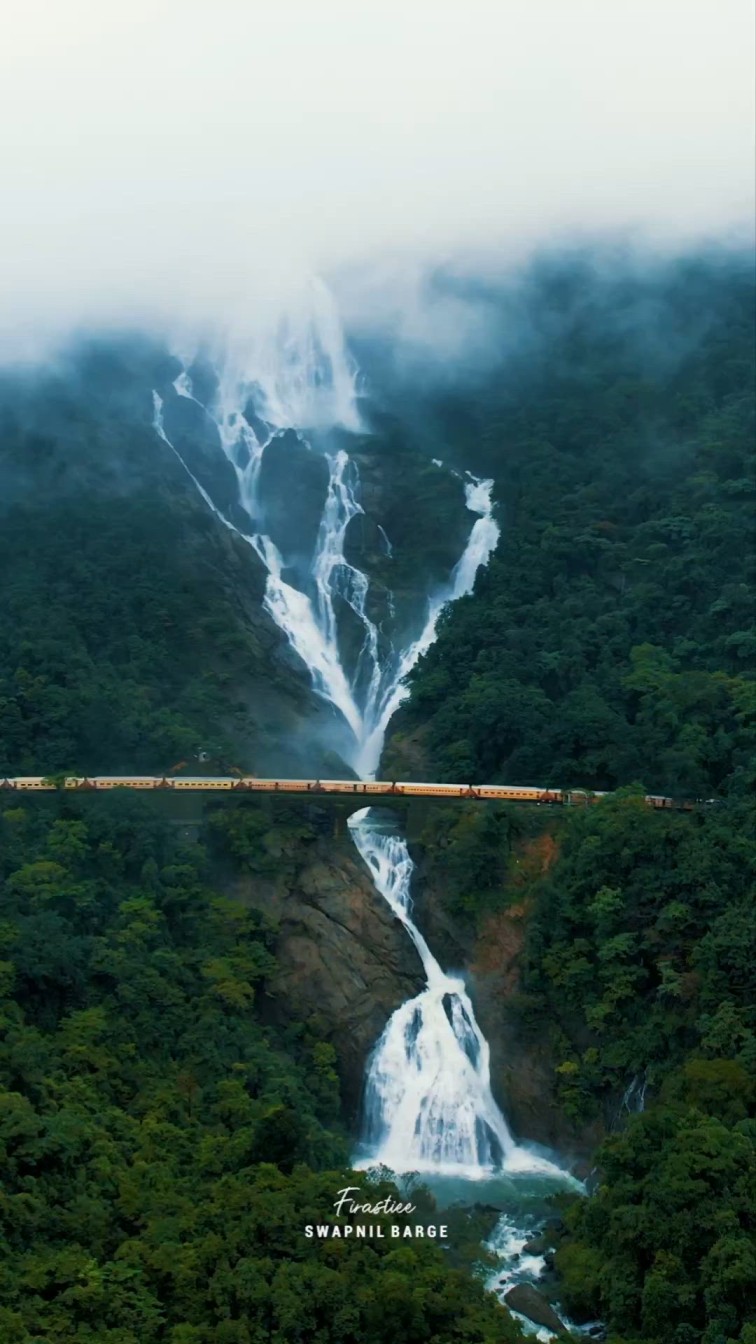
🌿 Western Ghats, India · Goa–Karnataka Border
Dudhsagar Falls: Where the Mountain Pours Milk into the Forest
One of India's tallest waterfalls at 310 metres — and one of its most dramatically beautiful. A destination that delivers on its reputation in every sense.
There are waterfalls you appreciate, and there are waterfalls that stop you completely — that produce a physical response before your mind has had time to process what your eyes are seeing. Dudhsagar Falls belongs emphatically in the second category. Tumbling down the face of the Western Ghats in four distinct cascades across a total height of approximately 310 metres, Dudhsagar is one of India's tallest waterfalls and, by near-universal agreement of those who have seen it, one of its most dramatically beautiful. The name means exactly what it sounds like — Sea of Milk — and when the falls are running at full volume after the monsoon, the white torrent of water crashing down dark basalt rock and generating clouds of mist genuinely does evoke an enormous pouring of milk down the mountainside.
Located on the Mandovi River on the border of Goa and Karnataka — within the Bhagwan Mahavir Wildlife Sanctuary and Mollem National Park — Dudhsagar occupies a position in the landscape that is as dramatic as the falls themselves. The surrounding forest is dense, the approach is an adventure in its own right, and the railway viaduct that spans the gorge just above the falls adds a human-made element of considerable grandeur that, rather than diminishing the natural scene, somehow amplifies it. This is a destination that delivers on its reputation in every sense.
The Falls: Scale, Character, and Visual Impact
Dudhsagar Falls drops in four tiers down the near-vertical face of the Western Ghats escarpment. The total height of approximately 310 metres places it among the top five tallest waterfalls in India, and its width of roughly 30 metres at its broadest point gives it a volume and presence that many taller but narrower falls lack. The uppermost cascade is the most powerful — a concentrated torrent that hits the first rock ledge and explodes into spray before gathering and falling again, and again, until it reaches the pool at the base.
The colour of the water is one of Dudhsagar's most distinctive characteristics. At peak flow — typically October through December — the water is so aerated by its long fall that it appears genuinely white from a distance, the milky quality that gives the falls their name not merely poetic but visually accurate. As the dry season progresses and the volume decreases, the water gradually reveals its natural blue-green clarity, and by March and April the falls have reduced to a series of slender threads against the dark rock — beautiful in a quieter way but a reminder that Dudhsagar is fundamentally a monsoon phenomenon.
The pool at the base of the falls is a natural swimming area of legendary appeal — the water is clear, cool, and refreshing, and swimming here with the falls roaring overhead and the forest closing in on every side is an experience that features prominently in the memories of everyone who has done it.
Getting There: The Journey Is Part of the Experience
Reaching Dudhsagar is an adventure that begins well before you arrive at the falls, and the approach itself is one of the destination's most compelling features.
The most popular route is by jeep safari from Mollem in Goa, approximately 45 kilometres from the falls. The Goa Forest Department runs regulated jeep safaris through the wildlife sanctuary, the vehicles making their way along forest tracks through the dense vegetation of Mollem National Park before crossing a stream and parking at the base of the final approach to the falls. The jeep journey takes approximately 45 minutes to an hour each way and passes through forest that is genuinely wild — leopard and gaur are present in the sanctuary, though sightings are more a matter of fortune than expectation.
The most atmospheric approach, however, is by train. Dudhsagar station — one of the few stations in India that exists primarily for its viewpoint rather than for any adjacent settlement — sits on the South Western Railway line between Kulem (Colem) in Goa and Castle Rock in Karnataka. Trains passing through this section cross the famous Dudhsagar Railway Viaduct — a multi-arched stone bridge built during the colonial era that spans the gorge directly above the upper falls. The view from a train crossing this viaduct — looking down at the white cascade of Dudhsagar below and the forest stretching away in every direction — is one of the most dramatic railway views in India, and one of those travel experiences that rewards the planning required to arrange it.
The train to Dudhsagar station (stopping trains on the Vasco-da-Gama to Londa/Hubballi route) allows visitors to disembark, spend time at the falls, and return on a subsequent service — though the schedule requires careful advance planning and the train option is best suited to travellers who have researched the timetable thoroughly.
The third access route is from Karnataka's side — from Bhimgad or Castle Rock — which involves a longer trek through forest but rewards those with sufficient time and fitness with a more immersive wilderness experience.
Wildlife and Ecology: The Forest Around the Falls
Dudhsagar sits within one of the most important protected forest areas in the Western Ghats — Bhagwan Mahavir Wildlife Sanctuary covers approximately 240 square kilometres of dense forest that is part of the larger Western Ghats UNESCO World Natural Heritage Site. The ecological richness of this forest is extraordinary, reflecting the biodiversity hotspot status of the entire Western Ghats range.
Gaur (Indian bison) — the largest wild cattle in the world — are regularly encountered along the forest tracks approaching Dudhsagar, particularly in the early morning when they emerge to graze in clearings. Their sheer size at close range is startling and memorable. Leopards are present throughout the sanctuary but rarely seen. Sambar and spotted deer are more reliably encountered. The forest also supports giant squirrels, porcupines, wild boar, and various mongoose species.
The birdlife of the Mollem forest is exceptionally rich. The Malabar pied hornbill is one of the most spectacular species regularly encountered, its distinctive call and large beak-casque making it unmistakable. Malaber trogons, Indian pittas, fairy bluebirds, hill mynas, and numerous species of woodpeckers, barbets, and bulbuls fill the forest with sound and colour. For birdwatchers, the forest around Dudhsagar is among the best sites in Goa and southern Karnataka, and combining a waterfall visit with early morning birdwatching in the forest can produce remarkable results.
The herpetofauna of the area is equally impressive — the Western Ghats are one of the world's most important centres of reptile and amphibian diversity, and the streams and forest floor around Dudhsagar support numerous frog species, many of them found only in this region, alongside various lizard and snake species including the king cobra.
Best Time to Visit: Timing Your Dudhsagar Experience
The timing of a Dudhsagar visit fundamentally shapes the experience, and the right time depends entirely on what you are primarily seeking.
The monsoon has ended or is ending, the falls are running at or near full volume, the forest is vivid green from the monsoon rains, the temperature is comfortable, and the jeep safari routes are passable. This is when Dudhsagar is at its most photogenic and most powerful.
Pleasant weather, reducing but still impressive water volume, and the clearest skies of the year — good for photography and comfortable for trekking.
The water volume decreases significantly, but the falls are still running and the reduced crowds make for a more peaceful experience. The swimming pool at the base is at its clearest and most inviting during this period.
Dudhsagar is closed to visitors — the monsoon makes the jeep tracks impassable and the forest trails dangerous, and water levels in the streams make the approach on foot hazardous. The falls are running at their most spectacular volume during this period, but access is not permitted for safety reasons.
Major Nearby Attractions: Making the Most of the Region
The location of Dudhsagar at the Goa-Karnataka border places it within reach of several other significant attractions that make for a rich regional itinerary.
Mollem National Park and the Devil's Canyon — within the same protected area — offer additional wildlife and landscape experiences. Tambdi Surla Mahadeva Temple — a 12th-century Kadamba-era temple deep in the forest near Mollem, built from basalt in a style that reflects the Hemadpanthi architectural tradition — is one of the most beautiful and least visited ancient temples in Goa, its forest setting giving it an atmosphere of remarkable serenity.
On the Goa side, the beach resorts and heritage sites of Old Goa — the Basilica of Bom Jesus, the Se Cathedral — are approximately 90 kilometres from Mollem and easily combined with a Dudhsagar visit as part of a broader Goa itinerary.
In Karnataka, the town of Dharwad and the heritage site of Badami are within reasonable driving distance for those approaching from the north, while the Coorg (Kodagu) district's coffee estates and wildlife are accessible for those with additional days to spend.
For Different Types of Travellers
🏕️ Adventure Enthusiasts
Will relish the jeep safari, the trek through forest, and the swimming in the base pool.
📸 Photographers
Will find Dudhsagar one of the most rewarding waterfall subjects in India — the combination of falling water, railway viaduct, forest, and mist creating compositional possibilities of extraordinary richness.
🐘 Wildlife Lovers
Will appreciate the sanctuary context and the genuine wilderness quality of the approach.
👨👩👧 Families
Can enjoy the jeep safari and the visual drama of the falls, though very young children and elderly visitors should note that the final approach involves uneven terrain and some stream crossing.
💑 Couples
Will find the forest setting and the falls themselves creating a naturally romantic atmosphere that needs no additional enhancement.
Practical Travel Tips
- The jeep safari from Mollem is the most straightforward access option and requires advance booking during peak season (October to March) — particularly on weekends and holidays when demand significantly exceeds supply. Book through the Goa Forest Department or registered operators in Mollem/Colem village.
- Carry waterproof bags for cameras and phones — the mist from the falls reaches visitors at the base pool and during stream crossings on the approach.
- Wear sturdy footwear with good grip for the uneven and potentially wet terrain.
- The forest department regulations limit visitor numbers and behaviour within the sanctuary — follow them carefully, particularly regarding waste disposal and wildlife disturbance.
- Accommodation options near Dudhsagar range from basic guesthouses in Mollem village to more comfortable options in Panjim or Margao in Goa, from which the falls are accessible as a day trip.
- For those approaching from Karnataka, Dharwad or Hubli offer accommodation before or after a visit.