🌿 Satpura Range · Chhindwara District · Madhya Pradesh
Tamia, Madhya Pradesh
A Satpura Hilltop Above the World's Most Mythic Valley
Where Dense Forests Meet an Ancient Tribal Civilisation
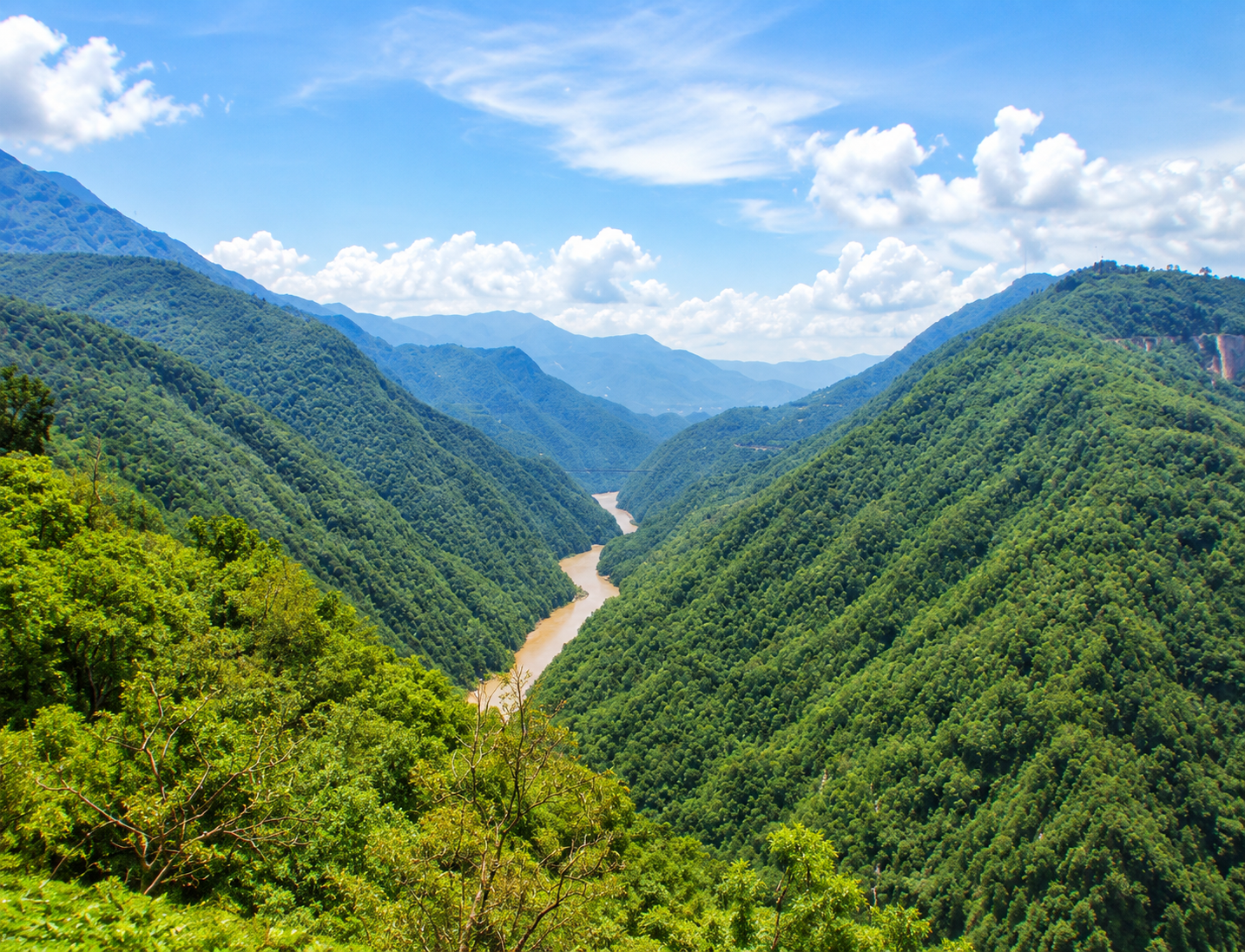
There is a moment, standing at one of Tamia's cliff-edge viewpoints at dawn, when the Patalkot Valley opens below you like something from another world. The forest drops away sharply, 400 metres straight down, into a horseshoe-shaped gorge of extraordinary depth and stillness — and somewhere down in that green shadow, invisible from here, the Bharia and Gond tribes are waking up in villages that have stayed untouched by the modern world for over five centuries. That view alone would make Tamia worth the drive. But there is considerably more to discover.
Tamia is a small hill station perched at approximately 3,765 feet above sea level in the Satpura Range, within the Chhindwara district of Madhya Pradesh. Sitting roughly 60 kilometres from Chhindwara city on the scenic road connecting Chhindwara to Pachmarhi, it occupies a strategic ridge position that gives it sweeping views across forested valleys in multiple directions. It is still largely uncommercialized — no flashy resorts, no weekend crowds — which is either a drawback or the whole point, depending on the kind of traveller you are.
🌀 The Star Attraction: Patalkot Valley
📖 The Name & The Myth
The name comes from Sanskrit — Patal means "very deep" — and the mythology that surrounds Patalkot gives Tamia much of its cultural gravity. Local belief holds that the valley was once the domain of Meghnad, son of Ravana, and that it served as a gateway to the underworld. The Bhonsle kings of the 18th century reportedly used its inaccessibility as a hideout after their defeat by the British, and old local accounts speak of a tunnel connecting Patalkot to Pachmarhi that has never been found.
🌿 The Bharia Tribe: Healers of the Hidden Valley
Today, the valley spans about 79 square kilometres and is home to around 2,000 people across 12 villages. The Bharia tribe — classified as a Particularly Vulnerable Tribal Group — have lived here in isolation for roughly 500 years. They are, above all, healers: the bhumka, or traditional medicine man, holds knowledge of over 200 medicinal plants that grow in the valley, and carries remedies for everything from snakebite to hypertension, diabetes to common ailments. Watching a bhumka lay out his dried herbs and explain their properties is an encounter unlike any standard cultural tourism experience.
To descend into Patalkot from Tamia, vehicles reach Kareyam village — about 20 kilometres away — and the rest is done on foot with a local guide. The trek through the valley floor passes waterfalls, dense forest, and the quiet rhythm of Bharia daily life. Tribal dances are occasionally performed for visitors at the campsite at Tamia, accompanied by the dhol, timki, and cymbals:
🌄 The Forest, the Viewpoints, and the Waterfall
- 🔭
Chimtipur Viewpoint Gives arguably the best overhead panorama of the Patalkot horseshoe — particularly at sunrise, when mist collects in the valley below and the ridgelines turn gold.
- 🏔️
Tamia Valley Viewpoint Offers a different perspective across the rolling forested hills of the wider Satpura region.
- 💧
Tamia Waterfall A seasonal cascade that forms on the hillside during monsoon. Draws visitors who come specifically for this frothy, short-lived spectacle.
🏛️ Colonial Heritage & Ancient Geology
The forest surrounding Tamia is old-growth Satpura jungle: dense, quiet, and alive. Ancient British-era bungalows still dot the hillside at some of the finest cliff-edge locations, lending the hill station an unhurried, nostalgic character that few places in central India can match. The rocks beneath the valley floor are Archaean — approximately 2,500 million years old — making Patalkot one of the geologically oldest landscapes accessible to tourists anywhere in India.
🐯 Wildlife and Wild Connections
The broader Satpura region hosts extraordinary wildlife, and Tamia sits at the gateway to it.
Around 100 km away — the landscape that inspired Rudyard Kipling's Mowgli stories — offers jeep and elephant safaris through territory shared by Bengal tigers, leopards, Indian bison, wild boar, and migratory birds including the Indian pitta and Malabar pied hornbill.
Established in 1981, lies in the same ecological belt and supports sloth bears, chinkara, and sambhar alongside its tigers.
💚 Who Should Visit Tamia
Nature lovers will be absorbed for days by the Satpura forests, the Patalkot ecosystem, and the sense of a landscape left largely alone. Photographers have outstanding material — the valley viewpoints at dawn, the tribal life in the villages below, the monsoon waterfall, and the colonial bungalows on the ridge. Solo travellers and couples seeking a genuine off-grid escape, away from the predictable hill station circuit, will find Tamia richly satisfying. Cultural travellers with an interest in tribal traditions and indigenous knowledge systems will find the Bharia encounter at Patalkot one of the most thought-provoking experiences in central India. Adventure enthusiasts have trekking into the valley, nature trails, and the Satpura Adventure Sports Festival held each October.
Families with children can manage the viewpoints and the forest comfortably; the full Patalkot descent requires some fitness and ideally a guide.
📅 Best Time to Visit
September to March is ideal. The post-monsoon months — September to November — offer the most vivid green landscapes when the forests are freshly washed and all the streams are running. Winter (December to February) brings pleasantly cool temperatures, clear skies, and crisp mornings. March and April are also comfortable. May heralds pre-monsoon heat. The monsoon (June to August) turns Tamia genuinely lush and the waterfall flows at full force, but forest trails become slippery and the Patalkot descent can be difficult after heavy rain.
🚗 How to Get There
Tamia sits on the Chhindwara–Pachmarhi road and is well-connected by road:
🚌 Getting Around
Buses and shared taxis ply between Chhindwara and Tamia. A private vehicle is strongly recommended for visiting Patalkot, as timings and trailheads require flexibility.
📌 Practical Tips
Accommodation: Motel Tamia (on the main road) is the standard option; Serendipity Lakes & Resort offers an eco-stay experience. For Patalkot, all stays are based in Tamia — there is no accommodation in the valley itself.
Guide for Patalkot: Hire a local guide in Tamia for the valley descent. Roads reach only as far as Kareyam village; the deeper villages are accessible only on foot.
Carry cash: Banking facilities in Tamia are basic. Stock up in Chhindwara.
Tribal etiquette: The Bharia villages are not a performance. Visit with humility, ask before photographing, and engage through your guide. The experience is richer for it.
Mobile signal: Patchy in the valley; better on the Tamia ridge. BSNL and Airtel offer the most consistent coverage.
Tamia is the kind of destination that people stumble across on the way somewhere else and quietly decide is the best thing they found. The valley below it holds a living culture and an ancient landscape that deserve a full day at minimum, and the hilltop itself has the rare quality of feeling genuinely remote while still being driveable in an afternoon from a major city. That combination doesn't stay undiscovered forever .
Nearby destination