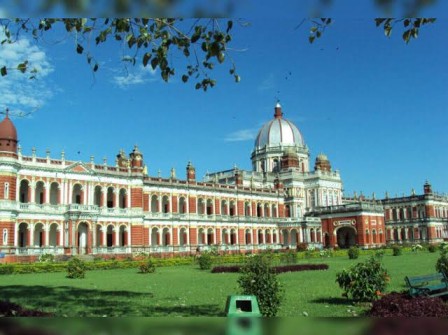
Victor Jubilee Palace · Completed 1887
Cooch Behar Palace — a Renaissance dome on the Bengal plains
An Italian-Renaissance royal residence built for the Koch dynasty, designed by F.W. Stevens and modelled on Buckingham Palace. Now an ASI-maintained Monument of National Importance in North Bengal.
Overview
Where the Koch dynasty met Victorian ambition
Rising from the plains of the Dooars in northeastern West Bengal, Cooch Behar Palace has stood for well over a century as one of India's most distinctive royal monuments — a place where Italian Renaissance grandeur meets the heritage of the Koch dynasty.
It was Maharaja Nripendra Narayan, educated in England and engaged with the Bengal Renaissance, who commissioned the palace. Completed in 1887 to coincide with Queen Victoria's Golden Jubilee, it served as both royal residence and the administrative nerve centre of the kingdom during a period of sweeping reform.
Architecture
Renaissance Europe realised in brick and dome
Designed by F.W. Stevens, architect of Mumbai's CSMT.
The brick-built structure draws direct inspiration from Buckingham Palace while realising it in the vocabulary of Italian Renaissance architecture. Its central dome, sheathed in silver, is ringed by Corinthian columns in a configuration reminiscent of St. Peter's Basilica, while the facade presents a rhythmic sequence of arches on alternating narrow and broad piers.
Inside, the palace once housed over 50 rooms, including the dodecagonal Durbar Hall, drawing rooms, a dining hall, a billiard room, a library, and the Toshakhana treasury. The original three-storey structure was partially damaged in the 1897 Assam earthquake; the restored two-storey building seen today retains its architectural coherence.
The Museum
Collections across three wings
Maintained by the Archaeological Survey of India.
Portraits & Photographs
Oil paintings and sepia-tinted royal photographs documenting the Cooch Behar royal family across generations.
Sculpture & Ceremonial Objects
Terracotta figurines, clay models, sandstone and laterite sculptures, chandeliers, arrows, and ceremonial pieces from the palace halls.
Regional Material Culture
A dedicated gallery on the customs and material culture of the region's indigenous communities.
Royal Milestones
Moments of historical consequence
Palace Completed
Built under Maharaja Nripendra Narayan, coinciding with Queen Victoria's Golden Jubilee.
Assam Earthquake
The original three-storey structure is partially damaged and later restored to two storeys.
Viceregal Visit
Viceroy Lord Curzon visits, underlining Cooch Behar's strategic standing within the British Raj.
Instrument of Accession
Maharaja Jagaddipendra Narayan signs the accession, merging Cooch Behar into the Indian Union.
Maharani Gayatri Devi, later a noted politician, was born within the palace walls before her marriage took her to Jaipur.
Seasonality
Reading the palace through the year
Recommended Window
Cool, clear North Bengal weather makes outdoor exploration of the gardens and facade genuinely pleasant.
Softer Light
Thinner crowds and gentler light favour photography of the dome and colonnade.
Tranquil Grounds
The palace gardens are particularly calm, suited to a slow, contemplative walk.
Access & Connectivity
Reaching Cooch Behar Palace
| From | Distance / Route | Notes |
|---|---|---|
| New Cooch Behar Railway Station | ~6 km from town centre | On the Barauni–Guwahati line; receives trains from Kolkata, Delhi, and Guwahati. |
| Local Transit | Station to Palace | Auto-rickshaws and taxis connect the railway station to the palace grounds. |
| Regional Bus Network | West Bengal, Assam, Bihar | State and private buses link Cooch Behar to key towns across the three states. |
The museum charges a modest entry fee and is closed on certain days of the week; timings are worth confirming before a visit.
Nearby Places to Explore