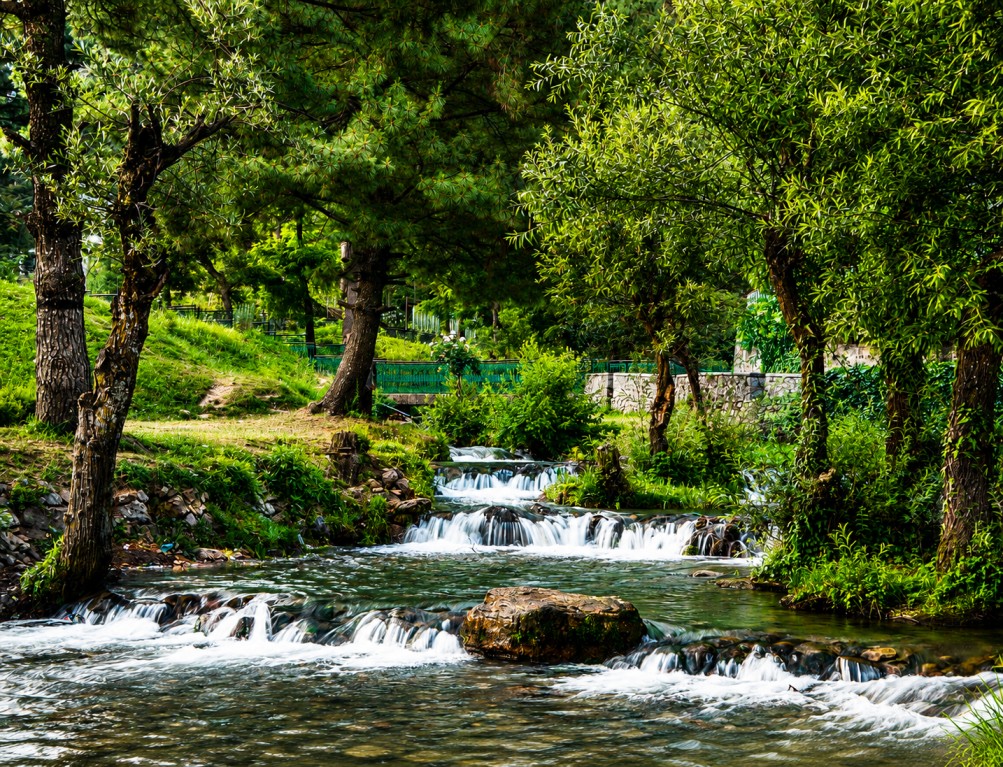
Kokernag
A spring-fed garden destination in the Breng Valley of South Kashmir's Anantnag district, built around one of Asia's largest freshwater springs and documented as a royal retreat since the Mughal era. This reference outlines the site layout, seasonality, and access relevant to South Kashmir itinerary planning.
Site character
Kokernag sits at roughly 2,000 metres in the Breng Valley, sometimes called the "Golden Crown of Kashmir," and takes its name from the main spring, which gushes from the base of a wooded limestone hill and divides into channels said to resemble a hen's claw. The site's medicinal reputation is documented as far back as the Mughal-era chronicle Ain-i-Akbari, which references the water's believed digestive and restorative properties.
Mughal emperors and courtiers are understood to have favoured Kokernag as a retreat, a legacy still visible in the botanical garden's layered lawns, fountains, and rose collections. The site's dual identity — royal garden and functioning fisheries facility — sets it apart from Kashmir's more purely ornamental gardens.
Spring system
Garden channels
Divided channels wind through the botanical garden's terraced lawns and chinar-lined pathways, forming the ornamental core of the site.
Hatchery pools
A branch feeds the adjacent trout hatchery, where stocked pools hold rainbow and brown trout across different life stages.
Forest run-off
Remaining flow continues through the surrounding pine and chinar forest that makes up part of the garden's wider 300-kanal footprint.
Points of reference
Kokernag Botanical Garden
Roughly 300 kanals of landscaped lawns and forest, with an extensive rose collection and centuries-old chinar trees.
Kokernag Trout Hatchery
One of Asia's largest trout breeding facilities, with stocked pools allowing observation of fish at varying life stages.
Achabal Gardens
A Mughal-era garden within reach of Kokernag, extending a South Kashmir garden-focused itinerary.
Daksum & Sinthan Top
Kokernag sits on the scenic route toward the Daksum valley and the high-altitude Sinthan Top pass.
On-site activity
Garden walks
Strolling through terraced lawns, rose beds, and chinar-shaded channels forms the core visitor experience.
Trout fishing
A fisheries department permit is required; equipment can be hired on site, with the fishing season running April to September.
Hatchery visits
Open to non-anglers, offering an educational view of the breeding and rearing process sustaining the wider Kashmir Valley trout population.
Picnicking
A popular weekend activity among local families, given the site's tranquil, spring-fed setting.
Operational notes
- Trout fishing requires a permit from the fisheries department, arranged in advance of the visit.
- Fishing equipment can be hired on site for visitors without their own gear.
- The fishing season runs from April to September, aligning with the garden's peak bloom window.
- Winter road conditions on the approach can be more challenging; confirm access before travel between November and February.
Seasonality
| Period | Conditions | Notes |
|---|---|---|
| APR — JUN | Recommended | Pleasant temperatures (roughly 15–25°C), peak garden bloom, and the height of the trout fishing season. |
| JUL — SEP | Fishing season continues | Fishing remains open through September; garden bloom moderates through summer. |
| SEP — NOV | Post-monsoon | Fewer crowds and attractive autumn foliage, with generally pleasant conditions. |
| NOV — FEB | Low season | Sharp temperature drop and more challenging road conditions; generally less favourable for visits. |
Access & connectivity
Primary air link, roughly two to two and a half hours by road via Anantnag.
On the Kashmir Railway line between Baramulla and Banihal, with onward travel by taxi or shared Sumo.
Regular buses and shared taxis run from Srinagar to Anantnag, with local transport covering the final stretch to Kokernag.
Complete Your Trip with Nearby Attractions