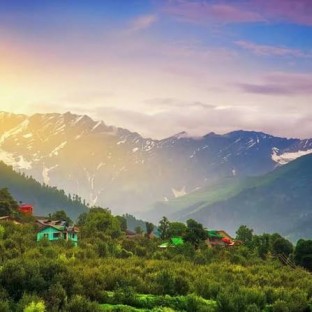
A cedar-forest meadow built around one of India's oldest golf courses
Naldehra sits at 2,044 m in the Shimla district, developed as a colonial-era retreat around the nine-hole golf course Lord Curzon established here in 1905. Deodar and cedar forest, open meadow, and the Mahunag Temple give it a quieter register than central Shimla, suited to leisure and short-stay itineraries rather than high-volume sightseeing.
Geography and landscape
Deodar, pine, oak and cedar forest cover the hills around Naldehra, opening onto rolling meadow at the golf course itself.
Forest cover
Dense deodar, pine, oak and cedar forest keeps the area cool through summer and gives the destination a consistently green, quiet character.
Open meadow
Rolling meadows at the golf course itself are the destination's most distinctive landscape feature, framed by apple orchards and terraced farms nearby.
Himalayan sightlines
Snow-clad Himalayan ranges are visible across the horizon on clear days, with occasional winter snowfall over the surrounding forest.
Colonial and religious heritage
Naldehra's identity rests on two distinct threads — a British-era golf course and a local serpent-deity temple still active in community life.
Naldehra Golf Course
Established in 1905 by Lord Curzon, then Viceroy of India, the nine-hole course set within deodar forest remains one of the oldest and most scenic golf courses in Asia, and draws non-golfing visitors for the walk alone.
Mahunag Temple
Dedicated to a local serpent deity, the temple sits amid cedar forest and continues to hold genuine significance for residents of the region, distinct from the colonial-era golf heritage.
Seasonality
Two clear windows for golf and sightseeing, and a distinct winter-snow period.
Product themes
The destination's core draws, organised by what each supports on the ground.
Golf tourism
The historic nine-hole course is the anchor product, with course access bookable in advance — a genuine point of difference for golf-interested groups.
Leisure & relaxation
Naldehra's quieter register compared to central Shimla suits couples and families seeking a slower-paced hill stay rather than dense sightseeing.
Horse riding & forest trails
Horse riding through cedar forest, alongside hiking, mountain biking and village walks, gives soft-adventure product without technical difficulty.
Photography
The colonial-era golf course, mist-covered forest, traditional wooden houses and Himalayan backdrops give strong year-round photographic variety.
Wildlife and birding
Surrounding forest supports Himalayan black bear in remote areas, barking deer, ghoral, langur, red fox, Himalayan monal, pheasant, woodpecker and eagle species.
Circuit positioning
Naldehra sits within reach of Shimla, Mashobra, Craignano Nature Park, Tattapani, Kufri and Chail — a strong base for the wider Shimla region.
Access and routing
Road-linked from Shimla, with rail access via Kalka and the Kalka–Shimla toy train as an optional scenic leg.
| Gateway | Distance / Note | Onward journey |
|---|---|---|
| Shimla Airport (Jubbarhatti) | Approx. 35 km | By road direct to Naldehra |
| Kalka Railway Station | Main railhead | Kalka–Shimla toy train to Shimla, then road onward |
| Road network | Regular bus & taxi links | Connects to Shimla, Chandigarh and nearby destinations |
Notes for itinerary planning
Practical points relevant to routing and guest briefing.
- Golf access: Course availability should be checked and booked in advance for golf-focused itineraries.
- Layering: Day-to-night temperature swings are significant at this elevation; layered clothing is advisable year-round.
- Temple etiquette: Standard local custom applies when visiting Mahunag Temple.
- Footwear: Comfortable walking shoes suit both forest trails and general sightseeing around the meadow.
- Circuit use: Works well as a short add-on to a Shimla-based itinerary rather than as a standalone multi-day stay..
Nearby Places To Visit