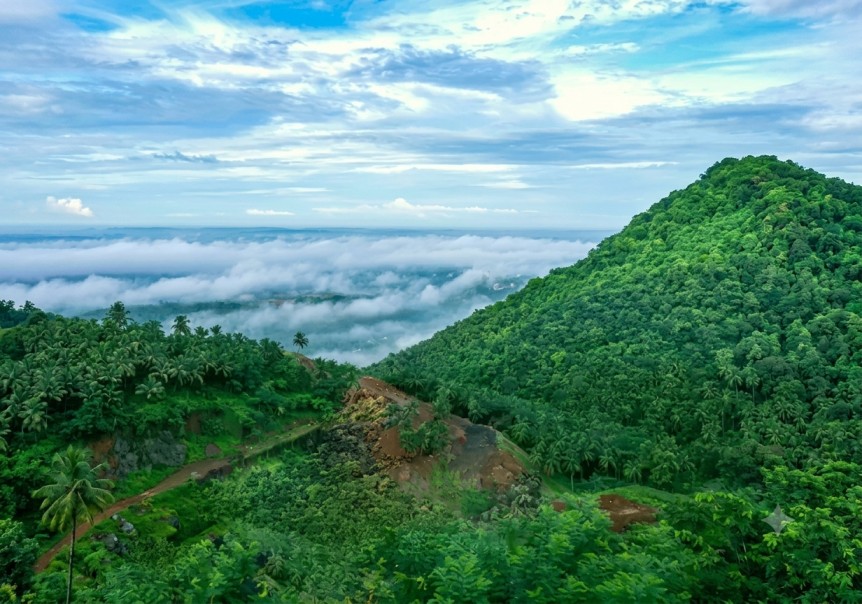
🏔️ Arimbra Hills, Kerala: Where the Western Ghats Keep Their Quietest Secrets
There is a particular kind of travel experience that has become increasingly rare in India — the discovery of a place that has not yet been packaged, promoted, and optimised for mass consumption. Arimbra Hills in Kerala belongs to that diminishing category of destinations where the landscape is genuinely unspoiled, the atmosphere genuinely unhurried, and the experience of simply being there genuinely restorative in ways that more famous hill stations, however beautiful, can no longer quite deliver.
Located in the Malappuram district of Kerala, in the lap of the northern Western Ghats, Arimbra Hills rises from the surrounding plains with the quiet authority of a place that has been doing this — being magnificent — for a very long time without requiring anyone's validation. The hills form part of the broader Western Ghats ecosystem, a UNESCO World Natural Heritage Site and one of the world's eight biodiversity hotspots, and they carry all the ecological richness that designation implies — dense forest cover, extraordinary biodiversity, clean streams, and an air quality that urban visitors find almost disorienting in its purity.
For travellers who have exhausted the better-known Kerala destinations — who have done Munnar and Wayanad and are looking for something that feels less curated and more genuine — Arimbra Hills offers exactly that: the Western Ghats in a form closer to their natural state, experienced at a pace that the landscape itself seems to set.
🌿 Natural Beauty and Landscape: The Ghats at Their Most Elemental
The landscape around Arimbra Hills is a study in what the Western Ghats look like when left largely to their own devices. Dense shola forests — the cloud forest ecosystems unique to the higher elevations of South India — alternate with grasslands, stream valleys, and rocky outcrops that offer panoramic views across the surrounding countryside. The hills roll and tumble in the characteristic Ghats fashion, each ridge revealing another beyond it, the layers of green deepening toward the horizon in gradations that shift through the day as the light changes.
The forest cover around Arimbra is exceptional, comprising a mix of tropical moist deciduous forest at lower elevations transitioning to semi-evergreen and evergreen forest as the elevation increases. This diversity of forest types supports an equally diverse range of flora — from the towering rosewood and teak of the lower slopes to the gnarled, moss-covered trees of the higher shola patches, their branches draped with epiphytic ferns and orchids that give them an ancient, primordial character.
Water is everywhere in the Arimbra landscape — streams tumbling down rocky channels, small waterfalls visible from the hillside paths, and the larger rivers of the Malappuram district flowing through the valleys below. After the monsoon, this watery presence reaches its most dramatic expression, the streams running full and fast and the entire hillside seemingly alive with the sound and movement of water finding its way downhill.
☀️ Climate: When to Go and What to Expect
The climate of Arimbra Hills follows the typical Western Ghats pattern — heavily influenced by both the southwest monsoon (June to September) and the northeast monsoon (October to November), with a relatively dry and pleasant period from December through April that represents the best time for most visitors.
October to February: post-monsoon landscapes are at their most vivid green, the air is clear and cool, and streams run strongly. Temperatures range from approximately 15°C at night to 25°C during the day — comfortable for walking and trekking.
June to September: transforms the hills into landscapes of extraordinary drama with mist, cloud, and waterfalls at full volume. The green vegetation reaches an almost artificially vivid intensity. Rewarding for those who accept practical limitations.
May and December: ideal for those seeking moderate weather and fewer crowds. Still experience good forest cover and flowing water systems without peak season tourism intensity.
The peak visiting season runs from October to February, when the post-monsoon landscape is at its most vivid green, the air is clear and cool, and the streams are still running strongly from the monsoon rains without the disruption that actual monsoon conditions bring. Temperatures during this period are refreshingly cool by Kerala standards — ranging from approximately 15°C at night to 25°C during the day — making it comfortable for walking, trekking, and outdoor activities.
The monsoon itself — while making access more challenging and some activities impossible — transforms the hills into a landscape of extraordinary drama, with mist and cloud moving through the forest, waterfalls running at full volume, and the green of the vegetation reaching an intensity that seems almost artificially vivid. Travellers who specifically seek monsoon landscapes and can accept the practical limitations the season imposes will find Arimbra Hills particularly rewarding during this period.
🥾 Trekking and Adventure: The Hills on Foot
For trekking enthusiasts, Arimbra Hills offers routes of varying difficulty through forest and grassland that provide genuine wilderness experiences without requiring the expedition-level preparation that Kerala's higher peaks demand. The trails — some established, others more informal paths known primarily to local guides — wind through dense forest, cross streams on stepping stones, and emerge periodically onto open viewpoints that reward the effort of the climb with panoramas of considerable beauty.
👥 Guided Trekking with Local Experts
The best trekking experiences in the Arimbra area are those undertaken with local guides — residents of the surrounding villages who know the forest intimately, can identify its plants and birds, and whose presence both enhances the experience and ensures responsible navigation of a sensitive ecological area. Several community-based tourism initiatives in the Malappuram district have developed guided trekking programmes that combine the adventure of the hills with genuine cultural exchange and direct economic benefit to local communities.
Rock formations scattered across the hillsides create opportunities for bouldering and basic rock climbing that attract adventure-oriented visitors. The rocky outcrops also serve as natural viewpoints — elevated platforms from which the surrounding landscape reveals itself in its full scale and complexity.
Cycling on the roads and tracks that wind through the lower portions of the Arimbra area has become increasingly popular, the gradients challenging enough to be interesting without being prohibitive for reasonably fit riders, and the scenery consistently rewarding throughout.
🦁 Wildlife and Biodiversity: The Forest's Inhabitants
The forests around Arimbra Hills support a wildlife community that reflects the broader richness of the northern Western Ghats ecosystem. Leopards are present in the area, though sightings are rare and generally limited to camera trap images rather than direct encounters — their presence is more felt than seen, a reminder that these are genuinely wild forests rather than managed wildlife parks.
More readily encountered are the smaller mammals of the Ghats forest — giant squirrels leaping through the forest canopy, mongooses hunting along stream banks, porcupines leaving their characteristic traces in soft mud, and the various deer species that browse the forest edges at dawn and dusk.
🐦 Birdwatching Paradise
For birdwatchers, Arimbra Hills is a location of real interest. The Western Ghats are one of India's most important Endemic Bird Areas, and the forests around Arimbra support a range of species found nowhere else in the world. The Malabar trogon, great hornbill, Nilgiri flycatcher, white-bellied treepie, and various species of laughingthrushes and babblers are among the birds that reward patient observation in the forest. The dawn chorus in these forests — when dozens of species begin calling simultaneously as the light strengthens — is one of those experiences that converts casual birdwatchers into enthusiasts and confirmed enthusiasts into obsessives.
Reptile diversity is also notable — various gecko species, pit vipers, and the magnificent king cobra are all recorded from the Western Ghats forests of Malappuram district, though encounters with the larger and more dangerous species require significant forest time and a degree of good fortune.
🎭 Culture and Local Life: Malappuram's Rich Heritage
The hills exist within a broader cultural landscape of considerable richness. Malappuram district is a region of deep historical significance — it was a centre of the Moplah (Mappila) Muslim community, whose unique culture represents a centuries-long synthesis of Arab maritime influence and Malayali tradition that produced its own architectural style, culinary tradition, and musical heritage.
🎵 Mappila Songs: Living Cultural Heritage
The Mappila songs (Mappila Pattu) — a musical tradition blending Arabic, Persian, and Malayalam linguistic and melodic elements — have been recognised as an important intangible cultural heritage of Kerala and are performed at community events throughout Malappuram. Encountering this music in its home cultural context — at a local celebration, at a mosque during a festival, or at a cultural programme in one of the district's towns — is an experience that adds genuine depth to a visit to the Arimbra Hills area.
🍲 Culinary Excellence: Mappila Cuisine
The cuisine of Malappuram is itself a compelling reason to visit. The Mappila culinary tradition produces some of Kerala's most distinctive food — Malabar biryani (considered by many food writers to be among the finest biryanis in India), pathiri (a thin rice flour flatbread), kallummakkaya (mussels prepared in various ways), and an extraordinary range of seafood preparations that reflect the coastal connections of the district even in its inland hill areas.
Local markets and weekly bazaars in the towns and villages surrounding Arimbra Hills offer opportunities to encounter the everyday life and commerce of the region — spices, vegetables, traditional textiles, and crafts that reflect the living culture of Malappuram's communities.
👥 For Different Types of Travellers
Will appreciate the relatively gentle terrain of the lower hill areas, the clean environment, and the cultural experiences that give children genuine encounters with a living traditional culture.
Seeking a romantic retreat will find the forest atmosphere, the cool climate, and the absence of crowds creating conditions of natural intimacy that more famous hill stations struggle to provide.
Will find the landscape, the light, and the bird and wildlife opportunities endlessly rewarding.
Will appreciate the ecological integrity of an area that has not yet been compromised by mass tourism infrastructure.
🚗 How to Reach Arimbra Hills
The nearest major transport hub is Calicut (Kozhikode), approximately 60–80 kilometres from the Arimbra Hills area, well connected by air, rail, and road to all major Indian cities. From Calicut, the hills are accessible by road through the towns of Malappuram and Tirur, with the final approach via local roads that require either a private vehicle or local transport. Malappuram town itself is well connected by road and rail and serves as a useful base for exploring the surrounding hills.
Fly into Calicut (Kozhikode) International Airport, approximately 60-80 km away. Connected to all major Indian cities.
Trains available to Calicut and Malappuram. Malappuram serves as an excellent base for exploring the surrounding hills.
Direct road access via Malappuram and Tirur towns. Final approach requires private vehicle or local transport through local roads.
Attractions Around [Arimba hills]