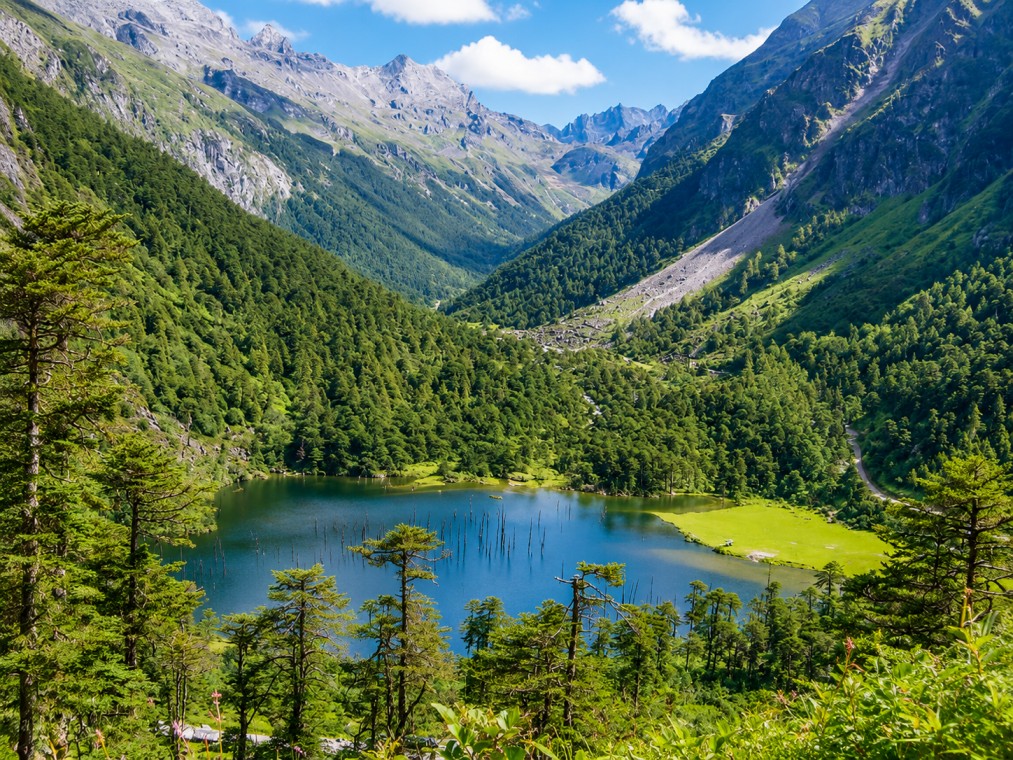
🏔️ Madhuri Lake — Sangestar Tso (Arunachal Pradesh)
📖 Overview
Madhuri Lake stands as one of the most hauntingly beautiful, geologically remarkable, and atmospherically distinctive high-altitude lakes in northeastern India, a body of still water set among the snow-capped peaks of the Eastern Himalayas whose tranquil surface, ghostly submerged forest, cascading mountain waterfall, and proximity to the Indo-China border together create a destination of rare and layered character that rewards the considerable effort required to reach it. Officially known as Sangestar Tso — a name of Tibetan origin that reflects the deep cultural and geographical connection between this part of Arunachal Pradesh and the Tibetan Buddhist world that has shaped its civilisation for centuries — the lake is situated in the Tawang district of Arunachal Pradesh at an altitude of approximately 3,708 metres above sea level, approximately 30 kilometres northeast of Tawang town along the road that leads to the Bum La Pass and the Indo-China border.
The lake's origin is geological rather than glacial, born from one of the most powerful seismic events in the recorded history of the subcontinent — the great Assam earthquake of 1950, one of the largest earthquakes ever measured anywhere in the world, whose violent tremors caused massive landslides across the Eastern Himalayas, sending boulders, soil, and trees cascading down the surrounding slopes in quantities sufficient to dam the mountain stream and create the lake that now fills the valley below.
The evidence of this violent origin is visible in one of the most striking and visually distinctive features of the landscape — the skeletal trunks of trees that were submerged at the moment of the lake's formation and still stand erect in the water decades later.
The lake acquired its popular name — Madhuri Lake — following the filming of a song sequence from the 1997 Bollywood film Koyla at this location, featuring the celebrated actress Madhuri Dixit dancing against the backdrop of the lake and its surrounding mountain landscape.
🌟 Why Visit Madhuri Lake
The most compelling reason to visit Madhuri Lake is the singular and deeply atmospheric quality of the landscape it presents — a quality produced by the specific and unrepeatable combination of the still, mirror-like surface of the high-altitude lake, the ring of snow-capped Eastern Himalayan peaks that frame it on every side, the ghostly vertical trunks of the submerged forest rising from the water, the waterfall that descends from the mountain above the lake into its upper end, and the yaks that graze along its shores.
Madhuri Lake also occupies a position of considerable strategic and emotional significance as a destination on the route to Bum La Pass.
📍 Key Highlights Within the Area
The lake itself, with its still and reflective surface catching the surrounding peaks and the deep blue of the high-altitude sky in a mirror image of exceptional clarity, is the central and defining feature of the destination.
🚶 Activities
Lake walking and shoreside photography are the primary activities at Madhuri Lake.
Visiting Bum La Pass as part of the same day excursion from Tawang provides the most comprehensive engagement with the high-altitude landscape.
Birdwatching along the lake shore rewards patient observers with sightings of migratory and resident species.
📅 Best Time to Visit
The most favorable period to visit Madhuri Lake is from April to June and from September to October.
The monsoon from July to August brings cloud and reduced visibility.
Winter from November to February often makes the lake inaccessible due to snow.
🚗 Connectivity
Madhuri Lake is accessible only from Tawang and requires permits.
The nearest major gateway is Guwahati, connected via road journey through Bhalukpong, Bomdila, and Sela Pass.
Near by destination