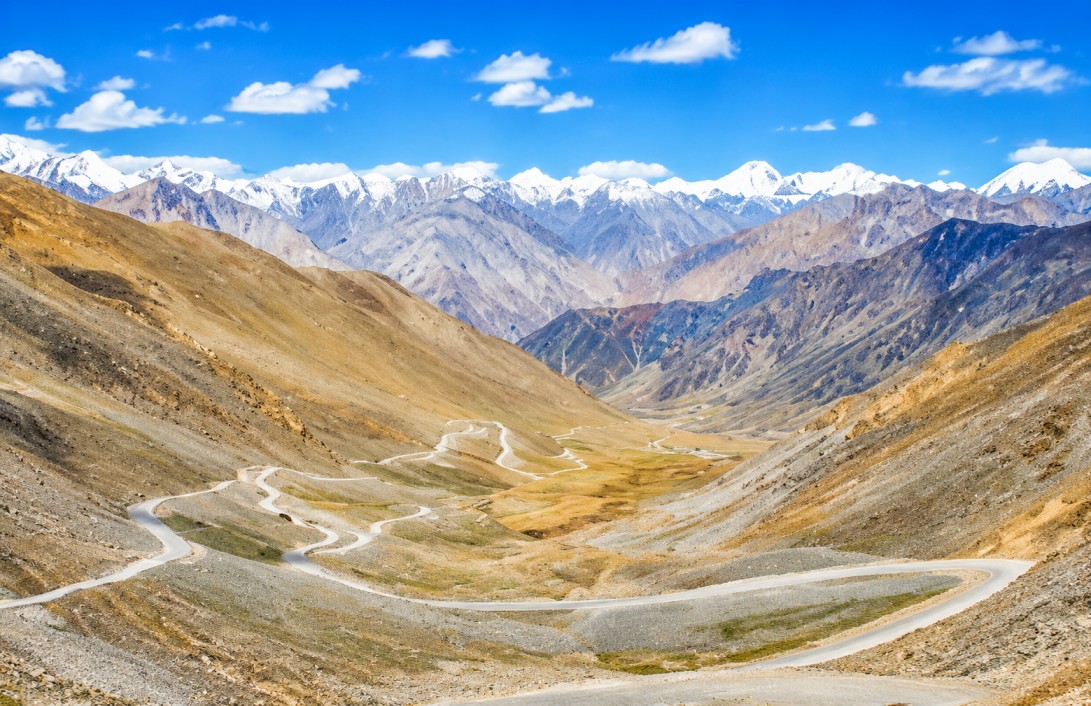
Khardung La Pass
One of the world's highest motorable mountain passes, connecting Leh to Nubra Valley and forming a mandatory routing point for any Ladakh itinerary with a Nubra or Siachen-facing component. High elevation makes this a scheduling-sensitive, not spontaneous, add-on.
Overview
Terrain & CharacterKhardung La sits in Ladakh, roughly 40 km from Leh, and functions as the physical and logistical gateway between the Leh valley and Nubra Valley. The pass is a through-route rather than a standalone destination, and itinerary design should treat it as a transit-and-viewpoint segment within a wider Leh–Nubra programme.
Natural Landscape
The terrain is defined by snow-clad peaks, rugged rock faces, glaciers, deep valleys and barren high-altitude ground. Snow patches persist along the road even in summer, while winter brings heavy snowfall and icy conditions. On clear days, sightlines extend across the Karakoram Range and the Ladakh Range toward the northern Himalayas.
History & Strategic Context
The pass historically formed part of the Silk Route, carrying trade caravans between Leh and Central Asia. It now holds strategic significance as a supply route toward Indian Armed Forces positions near the Siachen Glacier, and the road is maintained year-round by the Border Roads Organisation under extreme conditions.
Acclimatization Requirement
Non-Negotiable Scheduling ConstraintTravellers should spend a minimum of 48 hours acclimatizing in Leh before ascending to Khardung La. This should be built into the itinerary as a fixed requirement rather than an optional buffer, given the elevation gain and associated altitude-sickness risk.
Core Attractions
On-Route & Within RangeKhardung La Top
The pass summit, marked by prayer flags and milestone boards, functioning as the primary photo-stop and the highest point of the crossing.
Nubra Valley
Sand dunes, Bactrian camels, monasteries and village settlements, reached by continuing beyond Khardung La — the natural extension of any pass crossing.
Diskit Monastery & Hunder Dunes
Key Nubra Valley stops suited to combining with the pass crossing on a multi-day Leh–Nubra circuit.
Leh Palace & Shanti Stupa
Heritage and viewpoint sites in Leh itself, typically scheduled during the mandatory acclimatization period.
Panamik Hot Springs
A further Nubra Valley stop for itineraries extending past Diskit and Hunder.
Thiksey Monastery
A prominent monastery on the Leh side, suitable for cultural stops before or after the pass crossing.
Adventure & Outdoor Activity
Route-Based Formats- High-altitude road trips
- Motorcycle touring
- Photography
- Summit viewpoint stops
- Mountain biking
- Trekking
- Camping
- Landscape photography
Wildlife
The high-altitude terrain supports species adapted to extreme conditions, including Himalayan marmots, blue sheep (bharal), Himalayan ibex, Tibetan wolves, and occasional snow leopards in remote areas, alongside high-altitude birds such as golden eagles and choughs.
Cuisine
Ladakhi cuisine available in Leh and nearby villages includes Thukpa, Momos, Skyu, Tingmo, butter tea, chhurpi, yak cheese, khambir bread and local apricots. Cafés in Leh also serve Tibetan, North Indian and international menus.
Shopping
Leh Market is the primary retail point, offering Pashmina shawls, Tibetan handicrafts, prayer wheels, handcrafted jewellery, prayer flags, apricot products, woollen garments and carpets.
Seasonality & Access
Planning Reference| Window | Conditions | Best suited to |
|---|---|---|
| May – Sep | Road generally open and accessible | Standard scheduling window for the pass crossing |
| Oct – Apr | Heavy snowfall, intermittent road closures | Not recommended without confirmed BRO road status |
| Access point | Detail | Notes |
| Air | Kushok Bakula Rimpochee Airport, Leh | Direct connectivity to major Indian cities |
| Road | Approx. 40 km from Leh by taxi, motorcycle or private vehicle | Road status should be confirmed before departure |
Operational Notes
For Itinerary Planning