Puga Valley, Ladakh: Where the Earth Breathes Steam and the Sky Feels Infinite
🌋 Puga Valley, Ladakh: Where the Earth Breathes Steam and the Sky Feels Infinite
A Hidden Geothermal Marvel in the Heart of Changthang
🌄 Overview
Tucked deep in the southeastern corner of Ladakh, roughly 170 kilometres from Leh, Puga Valley sits within the sweeping high-altitude expanse of the Changthang Plateau — and it looks like nowhere else in India. Stretching about 30 kilometres through a narrow corridor of volcanic terrain, the valley is framed by brown and ochre mountains on every side, with wisps of sulphurous steam rising from the earth below. It is raw, remote, and genuinely extraordinary. Most travellers discover it while passing through on the Tso Moriri circuit, and almost all of them stop longer than planned.
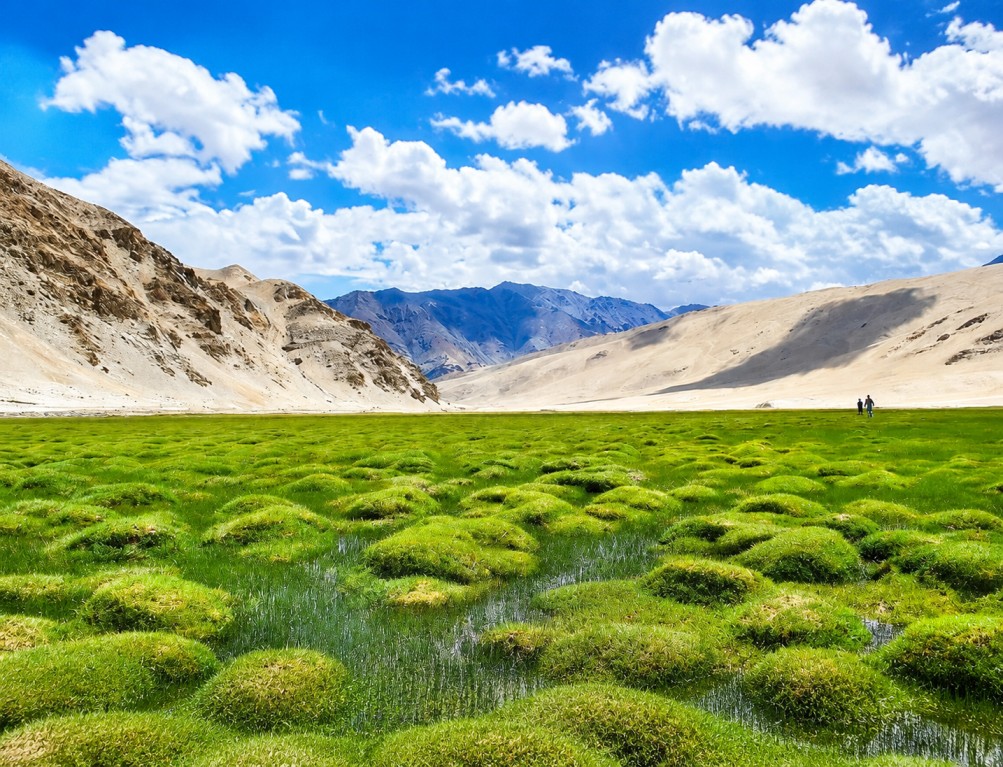
Puga became an unexpected internet sensation after a viral reel captured its surreal landscape — bright green wetland meadows against the starkness of bare Himalayan ridgelines, with steam venting quietly from the ground. That contrast tells you everything you need to know about why this valley is special: it is both otherworldly and oddly peaceful, a place where geological drama and natural stillness occupy the same frame.
🌋 The Geothermal Heart of India
What makes Puga Valley stand apart from every other valley in Ladakh is geology. The valley sits directly on the Himalayan geothermal belt and holds one of the richest concentrations of geothermal energy in the country. Sulphur deposits streak the hillsides in vivid yellow, borax crystals crust the edges of natural pools, and at Puga Sumdo — the most active thermal site in the valley — water literally boils up through the earth's surface. Watching it is quietly astonishing: a bubbling spring in a silent mountain landscape, steam drifting slowly upward into cold, clear Ladakhi air.
Scientists and energy researchers have long recognised Puga as India's most promising candidate for geothermal power generation. The National Institute of Hydrology and several government bodies have conducted studies here, and the valley may one day produce electricity from its natural heat. For now, though, it remains an open-air geological classroom — and a deeply atmospheric place to wander.
The hot springs are also said to carry therapeutic value. Local communities and visitors have long bathed in the mineral-rich waters, which are believed to ease rheumatism and certain skin conditions. While the springs are not developed into formal bathing facilities, soaking your feet at the warmer, shallower pools has become a small ritual for many travellers who pass through.
📸 Landscapes Made for Photography and Contemplation
Beyond the geothermal activity, Puga Valley offers a landscape of striking visual contrasts that rewards both the nature lover and the serious photographer. Lush green marshy meadows — vivid in summer and almost surreal against the barren mountain backdrop — sit alongside mud pools, steaming vents, and scattered mineral deposits in shades of cream, rust, and pale yellow. The sky here is immense and unpolluted; on clear nights, the stargazing is exceptional.
Wildlife rounds out the picture quietly. The surrounding Changthang region is part of the Changthang Wildlife Sanctuary, home to the Tibetan wolf, kiang (Tibetan wild ass), Himalayan marmot, and several species of migratory birds including bar-headed geese and, occasionally, the rare black-necked crane. Birdwatchers will find the marshy fringes of Puga's hot spring fields particularly productive during the summer months.
📍 Nearby Attractions Worth Combining
🏞️ Tso Moriri Lake (22 km away)
One of the most beautiful high-altitude lakes in the Himalayas, at 4,522 metres above sea level. The drive from Puga is stunning.
🤍 Tso Kar (The White Lake)
A high-altitude salt lake on the Rupshu Plateau, known for its white mineral shoreline and black-necked crane sightings.
🏡 Karzok Village
The nearest proper settlement to Puga, with homestays, a centuries-old monastery, and warm Changpa hospitality.
☸️ Nyoma Village
A quiet Indus-side hamlet with a historic Buddhist monastery, rarely visited and genuinely serene.
🔭 Hanle
Further east, Hanle is home to both a hilltop monastery and the Indian Astronomical Observatory — one of the best dark-sky stargazing sites in Asia.
🌿 Who Is Puga Valley For?
Nature lovers and geologists will find the thermal fields absorbing for hours — the variety of activity across even a small stretch is remarkable. Photographers have the rare combination of steam, colour, open sky, and stillness, best captured in the early morning light when the surrounding peaks turn golden. Adventure cyclists and bikers include Puga on Ladakh road trip circuits for its scenery and its frontier quality. Couples and solo travellers seeking something genuinely off-the-beaten-path — away from the crowds of Pangong and Nubra — will find Puga satisfying in a quieter, more contemplative way. Families with young children should plan carefully given the altitude and limited facilities, but the visual experience is one that children find genuinely memorable.
🌤️ Best Time to Visit Puga Valley
The valley is accessible from May to October, with the sweetest window falling between June and mid-September, when the meadows are at their greenest, roads are reliably open, and daytime temperatures are pleasant — typically 15–25°C. April and late October are possible but colder and less predictable. Winter (November to March) brings heavy snowfall and road closures that make Puga effectively unreachable.
🚗 How to Get There
Puga Valley lies approximately 170 kilometres from Leh, with a drive time of roughly 4–5 hours through mountain terrain. The standard route passes through Mahe Bridge and continues along the Tso Moriri road. A sturdy 4WD vehicle — Innova Crysta, Scorpio, or similar — is strongly recommended; the final stretches can be rough. Shared jeeps depart from Leh's taxi stand early in the morning and reach the valley by midday.
The nearest airport is Kushok Bakula Rimpochee Airport in Leh, with regular flights from Delhi, Srinagar, Mumbai, and Chandigarh.
🧳 Essential Travel Tips
🛂 Inner Line Permit
Required for Puga Valley as it falls within a restricted border zone. Obtain it in Leh before departing — the process is straightforward and same-day.
⛰️ Acclimatise First
The plateau sits between 4,400 and 4,600 metres. Spend at least two nights in Leh before heading out to avoid altitude sickness.
🥪 Carry Food and Water
There are no restaurants or shops at Puga. Pack sufficient snacks, water, and a thermal flask. Karzok (22 km) has basic provisions.
💵 Cash Is King
The nearest ATMs are in Leh. Carry enough cash for your entire circuit.
📶 Connectivity
Mobile signal is sparse; BSNL and Airtel postpaid connections offer the most reliable coverage in this region.
🏡 Stay in Karzok
For the full experience, spend a night at a guesthouse or homestay in Karzok, combining Tso Moriri at dusk with an early morning drive to Puga.
🌿 Leave No Trace
Puga's ecosystem is fragile. Keep to established paths, do not disturb the thermal pools, and carry out all waste.
🌍 The Bottom Line
Puga Valley is Ladakh without the crowds, without the filters, and without the usual tourist infrastructure — which is precisely its appeal. It is a valley that asks something of you: a willingness to drive a long road, to sit quietly beside a steaming spring, to look at mountains that most visitors will never see. For those who make the effort, the reward is one of those rare travel experiences that stays with you not because of what you photographed, but because of what you felt standing there in the silence, watching the earth breathe.
Nearby Places To Explore
Tso Moriri
Leh
Hemis National Park
Hemis Festival