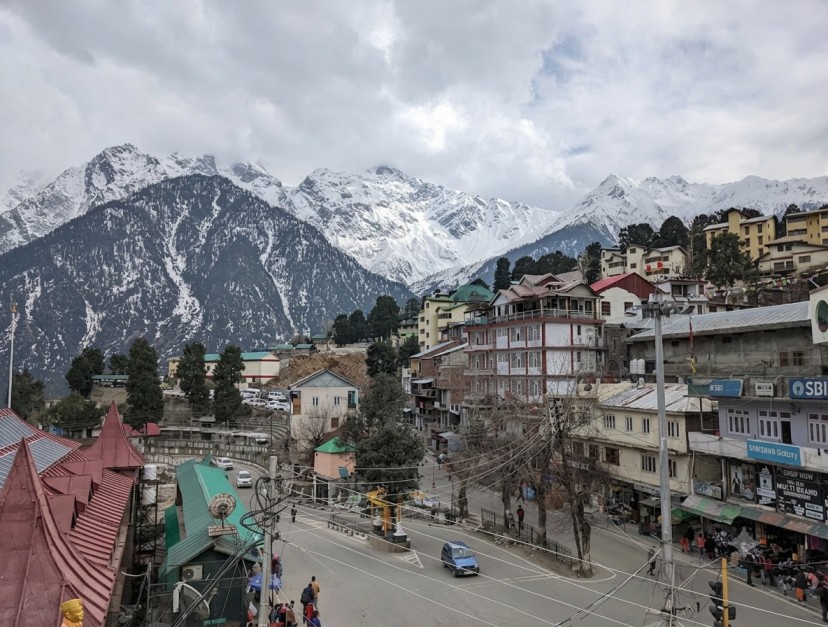
Reckong Peo
The administrative and cultural heart of Kinnaur — where Hindu temples and Tibetan gompas share a single valley, and the last major town before the road climbs on to Spiti.
Overview
Reckong Peo is the administrative headquarters of Kinnaur, a meeting point of Hindu and Tibetan Buddhist traditions set against the Kinner Kailash range. At an elevation of roughly 2,290 to 2,670 metres, the town — often called simply Peo — gives travellers their first view of the region's apple orchards, prayer-flag-strewn monasteries, and traditional Kinnauri culture.
Its position as the last major town before the Spiti route, its blend of temples and gompas within one valley, and its role as the practical starting point for the Kinnaur Kailash Parikrama give it a layered character beyond that of a simple administrative stop.
"One of the clearest views anywhere in the region of the Kinner Kailash Shivling — a 79-foot rock formation believed to change colour through the day." Kinner Kailash, from Reckong Peo
Two Traditions, One Valley
Kothi Chandika Temple
A wooden pagoda-style shrine to Goddess Chandika, believed to predate the town itself, blending Hindu motifs with Tibetan artistic influence.
Brelengi Gompa
Built for a Kalachakra ceremony held by the Dalai Lama, home to a towering standing Buddha statue and a serene contrast to the town's markets.
Highlights
Kinner Kailash from Peo
Travellers' first substantial glimpse of the sacred peak and its Shivling rock formation before continuing into the valley.
Kothi Chandika Temple
One of the region's most architecturally distinctive religious sites, fusing Hindu and Tibetan design.
Brelengi Gompa
A significant stop for Kinnaur's Buddhist heritage, built for a Dalai Lama Kalachakra ceremony.
Kalpa
Just 7km away and roughly 500m higher — traditional wooden architecture and even more striking Kinner Kailash views.
Activities
Temple & Monastery Visits
Moving between Kothi Chandika Temple and Brelengi Gompa to experience Kinnaur's blend of traditions.
Market Exploration
Kinnauri caps, handwoven woollens, chilgoza pine nuts, and local dishes — siddu, thukpa, momos.
Kailash Parikrama
An 8–10 day circumambulation trek around the sacred peak, starting from Reckong Peo.
Photography
Alpenglow lighting Kinner Kailash at sunrise, best from elevated points around the town.
Best Time to Visit
April to October is the most favourable stretch, spanning spring, summer and autumn, with comfortable weather and reliably open roads. Spring (March–May) brings blossoming apple orchards, ideal for photography. Summer (June–August) is warm and dry, suited to trekking. Autumn (September–November) combines golden foliage, clear skies and harvest energy — often the most visually striking window. Winter (December–February) brings heavy snowfall and dramatic peak views, but possible road closures, and is generally recommended only for experienced high-altitude travellers.
Connectivity
Reckong Peo sits on National Highway 5, the Hindustan-Tibet Road, roughly 225–260km from Shimla — a journey of about eight hours through Rampur and the Sutlej river valley.
Kinnaur has no railway or airport of its own; the nearest railhead and airport are both at Shimla, around 220–244km away, reached onward by taxi or HRTC bus. Local shared cabs and buses connect Reckong Peo to Kalpa, Sangla, and Rampur, and onward toward Spiti Valley via the Nako route.