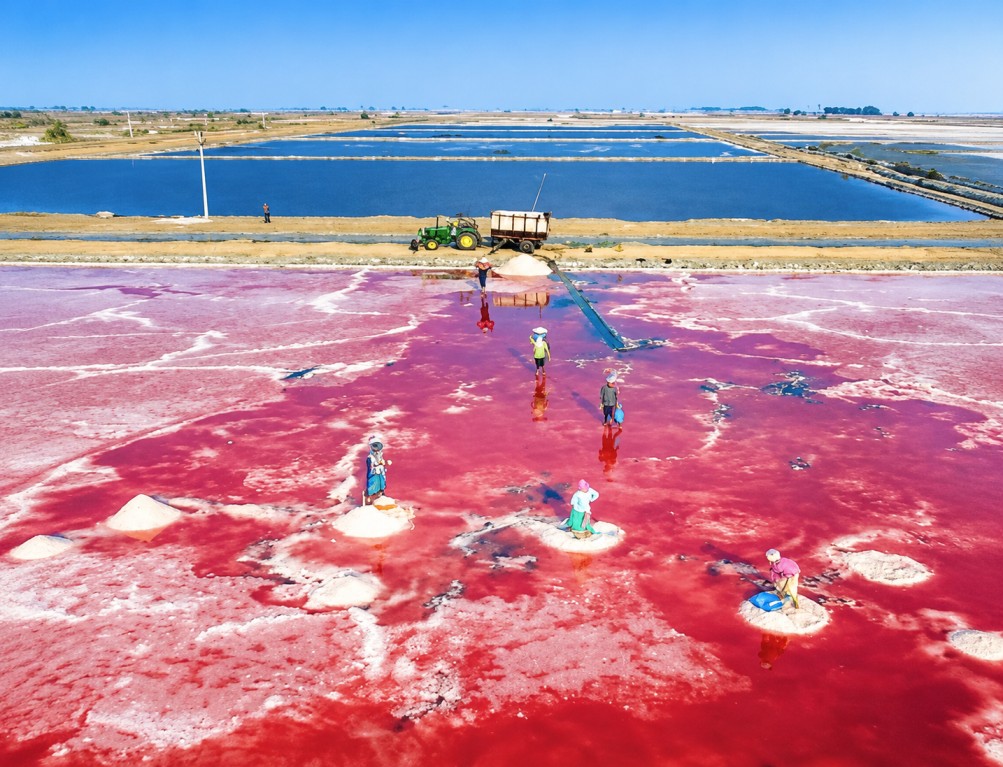
🏞️ Sambhar Lake, Rajasthan – Where the Desert Meets the Sky
Imagine standing at the edge of an endless stretch of silver-white salt, the horizon dissolving into pale sky, and thousands of flamingos wading through shallow brine just a few hundred metres away. The air carries a sharp mineral tang, the light is soft and golden, and for a moment, you wonder if you've wandered off the edge of the world into something entirely dream-like. That's Sambhar Lake for you — not just a natural wonder, but a state of mind. Cradled in the arid landscape of Rajasthan, roughly 80 kilometres southwest of Jaipur, this ancient saltwater lake is India's largest inland saline lake, and one of its most hauntingly beautiful secrets.
📜 A Little Bit of History First
Sambhar's story stretches back to mythology and medieval kingdoms. According to legend, the lake was created by the goddess Shakambhari, and her ancient temple still stands at the lake's edge, drawing pilgrims who have been making this journey for centuries. Historically, Sambhar was the heartland of the Chahamana (Chauhan) dynasty — the very clan that gave India the legendary warrior-king Prithviraj Chauhan. The ruins and remnants scattered across the surrounding landscape are quiet witnesses to that glorious Rajput past.
By the Mughal era, Sambhar's salt had become one of the most prized commodities in northern India, and control of the lake was fiercely contested. The British eventually took over salt production in the 19th century through the Sambhar Salt Works, an operation that continues to this day — making Sambhar simultaneously a place of mythology, medieval history, and living industrial heritage. Few destinations in India carry so many layers so lightly.
✨ The Attractions That Will Leave You Breathless
Sambhar Lake itself is the star attraction, and it needs no embellishment. At its fullest, it stretches across approximately 230 square kilometres, transforming into a vast mirror that reflects clouds and sky in equal measure. During the dry months, as water recedes, brilliant white salt crusts emerge — glittering, crystalline, and almost blindingly beautiful in direct sunlight.
The flamingo gatherings between November and February are among the most spectacular wildlife events in northern India. Thousands of lesser and greater flamingos descend upon the shallow waters, painting the pale landscape in brushstrokes of pink. Over 200 bird species have been recorded here, making Sambhar Lake a recognised Ramsar Wetland site of international importance for migratory birds.
The Shakambhari Mata Temple, perched at the lake's edge, is a deeply atmospheric pilgrimage site dedicated to an incarnation of Goddess Durga. During Navratri festivals, the temple comes alive with devotional energy, colour, and the sound of prayers rising across the still water.
Don't miss a visit to the Sambhar Salt Works, where you can witness the fascinating traditional and industrial process of salt extraction — a practice that has sustained communities here for over a thousand years. Walking the peripheral embankments of the lake at sunrise is an experience unto itself, with the morning light catching the flamingos and the salt flats simultaneously in an otherworldly glow.
🦩 Wildlife
The flamingo gatherings between November and February are among the most spectacular wildlife events in northern India. Thousands of lesser and greater flamingos descend upon the shallow waters, painting the pale landscape in brushstrokes of pink. Over 200 bird species have been recorded here, making Sambhar Lake a recognised Ramsar Wetland site of international importance for migratory birds.
🧂 Salt Flats
Sambhar Lake itself is the star attraction, and it needs no embellishment. At its fullest, it stretches across approximately 230 square kilometres, transforming into a vast mirror that reflects clouds and sky in equal measure. During the dry months, as water recedes, brilliant white salt crusts emerge — glittering, crystalline, and almost blindingly beautiful in direct sunlight.
🛕 Heritage
The Shakambhari Mata Temple, perched at the lake's edge, is a deeply atmospheric pilgrimage site dedicated to an incarnation of Goddess Durga. During Navratri festivals, the temple comes alive with devotional energy, colour, and the sound of prayers rising across the still water.
🎭 Culture, People, and Food
Sambhar and its surrounding villages carry the warm, unhurried character of rural Rajasthan. The communities here have lived alongside the lake for generations, and their lives, traditions, and festivals are deeply intertwined with its rhythms. Local markets in Sambhar town offer a glimpse into authentic Rajasthani daily life — colourful textiles, clay pottery, and the aroma of spiced chai drifting from roadside stalls.
For food, expect hearty and honest Rajasthani flavours — dal baati churma, ker sangri, and bajre ki roti served with generous dollops of ghee. Small local eateries around the temple complex and the town centre keep things simple and delicious. Pick up locally made salt as a memorable and entirely unique souvenir — Sambhar salt carries a trace mineral richness that sets it apart from ordinary table salt, and it makes for wonderful gifting.
📅 Best Time to Visit
November to February is the undisputed best time to visit, when migratory birds arrive in full spectacle, temperatures are cool and pleasant, and the winter light gives the lake a luminous, painterly quality. This period also coincides with major religious festivals at the Shakambhari Temple. October and March are excellent shoulder months with quieter crowds. April to June brings intense Rajasthan heat, but also the most dramatic salt flat landscapes as water fully evaporates. The monsoon months of July to September replenish the lake beautifully but make access trickier.
🚗 How to Get There
✈️ By Air
The nearest airport is Jaipur International Airport, approximately 80 kilometres away, well-connected to Delhi, Mumbai, Bengaluru, and beyond. Taxis to Sambhar take about two hours.
🚆 By Rail
Sambhar Lake Town Railway Station offers direct rail connectivity from Jaipur, Ajmer, and Jodhpur — a rare convenience for a natural heritage destination of this scale.
🛣️ By Road
Sambhar is easily reached by road from Jaipur (around 2 hours), Ajmer (around 1.5 hours), and Nagaur. State buses and private cabs make the journey comfortable.
💙 Why You Simply Must Visit Sambhar Lake
Some places demand your attention with noise and spectacle. Sambhar Lake earns it with silence and scale. It is the kind of place where the sheer vastness of sky, salt, and water recalibrates something deep inside you — where standing still feels like the most productive thing you could possibly do. Whether you're a wildlife enthusiast chasing flamingos at dawn, a history lover tracing Chauhan ruins, a pilgrim seeking the blessings of Shakambhari Mata, or simply a traveller hungry for beauty that doesn't look like anywhere else — Sambhar has something that will stay with you long after you've shaken the salt dust from your shoes.
So point your car southwest from Jaipur, let the city fade behind you, and let Sambhar do what it has always done best — remind you that India's most extraordinary places are often its most quietly kept ones.
Beyond the Main Attraction
Desert National Park
jorbeer conservation reserve
Jaisalmer- Desert- Festival
Pushkar Fair
Hawa Mahal
Jal Mahal
City Palace