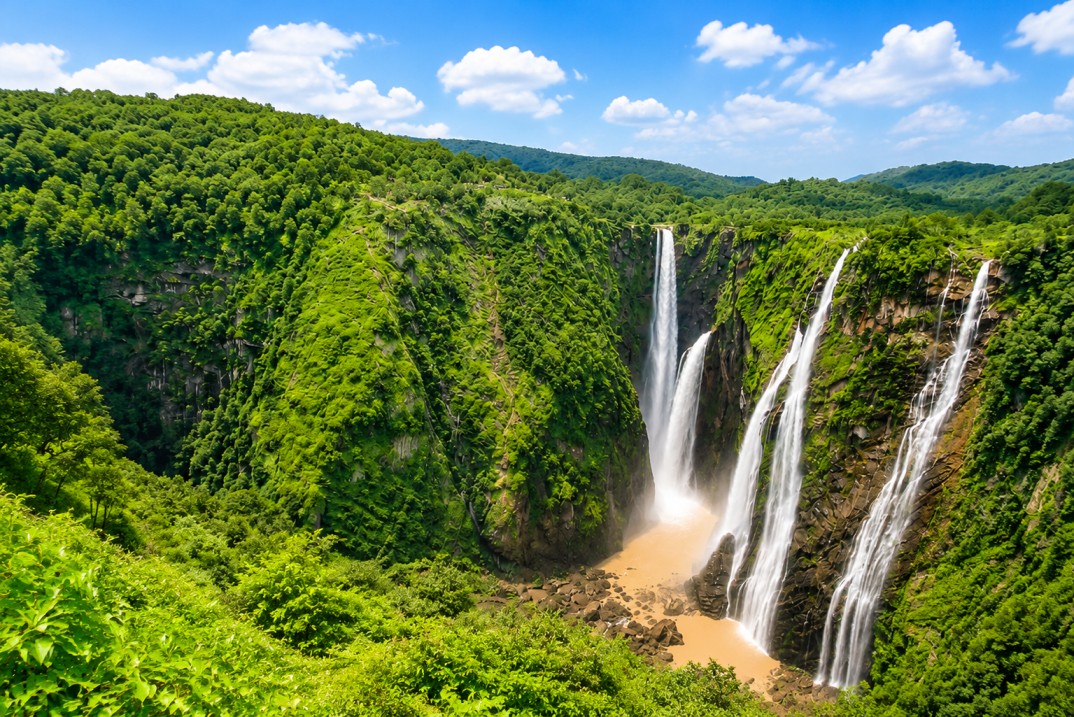
Karnataka, India · Malnad Region · Western Ghats
Shivamogga — Shimoga
Gateway to Malnad · Rice Bowl of Karnataka
📍 Overview
A Destination of Genuine and Varied Appeal
Shivamogga stands as one of the most naturally abundant and historically layered destinations in Karnataka, a district and city of considerable depth where the thundering cascades of some of India's most powerful waterfalls, the dense evergreen forests of the Western Ghats, a rich heritage of dynastic architecture, and the agricultural identity of the Malnad region converge into a destination of genuine and varied appeal. Situated in the central part of Karnataka on the banks of the Tunga River at an elevation of approximately 569 metres, Shivamogga serves as the headquarters of the district of the same name and carries the informal title of the Gateway to Malnad — a designation that reflects its position at the threshold of the hilly, forested, and waterfall-rich terrain of the Western Ghats that stretches westward from its boundaries toward the Konkan coast.
🕉️ The Name & Its Origins
The name Shivamogga is believed by traditional derivation to originate from the Sanskrit words Shiva Mukha, meaning the Face of Shiva — a reference to the district's position at the foothills of the Western Ghats and to the deep Shaivite religious tradition that has characterised this region of Karnataka across centuries. The district is also widely known as the Rice Bowl of Karnataka, as the four major rivers that flow through it — the Sharavathi, the Tunga, the Bhadra, and the Varada — have created a landscape of exceptional agricultural fertility that sustains extensive paddy cultivation, arecanut and coconut plantations, and the floriculture crops for which the region is locally celebrated.
The history of Shivamogga reaches back to the fourth century CE, when the region fell under the influence of the Kadamba dynasty, and was subsequently ruled by the Gangas, the Chalukyas of Badami, the Rashtrakutas, the Hoysalas, and the Vijayanagara kings, each leaving architectural and cultural traces across the district. After the fall of the Vijayanagara Empire in 1565 CE, the Keladi Nayakas — originally feudatories of Vijayanagara — declared sovereignty and ruled as an independent kingdom for nearly two centuries from their capital at Keladi, building temples, palaces, and a military tradition that brought them into direct conflict with Hyder Ali of Mysore, who captured the region in 1763 and brought Shivamogga into the Kingdom of Mysore. The British subsequently incorporated the district into their Mysore administration, and the area remained part of the Princely State of Mysore through to Indian independence.
What distinguishes Shivamogga from other districts of Karnataka is the extraordinary concentration of waterfalls it contains — including India's second-highest plunge waterfall and its highest waterfall — combined with a wildlife sanctuary of considerable ecological significance, a unique Sanskrit-speaking village, a heritage of Keladi Nayaka architecture of genuine interest, and a natural landscape of rivers, forests, and hills that provides some of the finest trekking and wildlife encounters in the Western Ghats.
✨ Why Visit
What Makes Shivamogga Unmissable
The most compelling reason to visit Shivamogga is the quality and variety of the natural experience it offers within a single district — a district where the most powerful waterfall in Karnataka falls in four distinct streams from a height of 253 metres, where the highest waterfall in India descends in a single column from 455 metres, where dense forests shelter elephants, leopards, and over 250 bird species, and where the rivers flow with a clarity and strength that make them among the most rewarding natural waterways in the Malnad region. No other district in Karnataka concentrates this density of waterfall spectacle and natural abundance within a comparable geographical area.
🗣️ Mattur — A Living Sanskrit Village
Shivamogga also offers the rare and genuinely unusual attraction of Mattur — a village on the banks of the Tunga River, approximately 8 kilometres from the city, where the entire community continues to conduct daily life in Sanskrit, making it one of the last places on earth where this ancient classical language is spoken as a living vernacular rather than a scholarly or liturgical medium. The existence of Mattur as a functioning Sanskrit-speaking community in the twenty-first century makes it one of the most extraordinary cultural curiosities in India and a destination that rewards a visit of considerable depth for those drawn to the living traditions of classical Indian civilisation.
The district's accessibility from Bengaluru — approximately 298 kilometres away — combined with its natural wealth, its wildlife and adventure activities, and its relatively undeveloped tourism character make it one of the most rewarding weekend and extended travel destinations in Karnataka for those who have moved beyond the more commonly visited hill stations and wildlife reserves of the state.
🗺️ Key Highlights
Attractions Within the Area
Jog Falls
Formed by the Sharavathi River as it plunges from a height of approximately 253 metres in four distinct cascades known locally as Raja, Rani, Roarer, and Rocket, is the most celebrated natural attraction in Shivamogga and one of the most spectacular waterfalls in the Indian subcontinent. The falls are the second-highest plunge waterfall in India and have been recognised for their extraordinary visual scale since the earliest British descriptions of the Malnad landscape. The Raja cascade, the most powerful of the four, falls in an unbroken column of exceptional volume, particularly in the post-monsoon months when the full flow of the Western Ghats rainfall moves through the Sharavathi system, creating a spectacle of water, mist, and sound that dominates the surrounding gorge for a considerable distance. Viewpoints above and below the falls allow the full four-cascade panorama to be appreciated from different angles, and the descent to the base — a long staircase of several hundred steps — brings visitors to within immediate reach of the falls' spray in an encounter of considerable physical impact.
Kunchikal Falls
Located near Masthikatte in the district and formed by the Varahi River descending from the Bhadra reservoir, cascades from a height of approximately 455 metres — the highest waterfall in India — through a heavily forested gorge of the Western Ghats that keeps it relatively hidden and inaccessible by comparison with the more famous Jog Falls. The restricted access to Kunchikal, which requires permission from the electricity generating authority that controls the surrounding area, preserves its character as a genuinely secluded natural discovery and makes the effort of reaching it particularly rewarding for those who make the journey.
Sharavathi Wildlife Sanctuary
Spread across approximately 431 square kilometres of dense moist deciduous and semi-evergreen forest surrounding the Linganamakki Reservoir and the upper Sharavathi catchment, is one of the most ecologically significant protected areas in the Western Ghats of Karnataka, home to elephants, gaur, leopards, sambar, barking deer, giant squirrels, and a birdlife of over 250 species that includes the Malabar grey hornbill, the great pied hornbill, and numerous endemic and migratory species that make the sanctuary one of the most productive birding destinations in the Malnad region.
Sakrebailu Elephant Camp
Situated approximately 16 kilometres from Shivamogga city on the Thirthahalli Road and maintained by the Karnataka Forest Department on the banks of the Tunga River, is one of the finest and most ethically managed elephant camps in Karnataka, housing trained and rehabilitated elephants and offering morning sessions during which visitors can observe the bathing, feeding, and exercise of the resident animals at close quarters in a riverine setting of considerable natural beauty.
Keladi Rameshwara Temple
Located approximately 8 kilometres from Sagara and built during the reign of the Keladi Nayakas in the sixteenth century, is the most historically significant architectural monument in the district — a temple of considerable elegance that combines Hoysala, Dravidian, and Kadamba architectural influences in a synthesis unique to the Nayaka period, with stone pillars and sculptural panels of remarkable quality that reflect the artistic ambitions of a dynasty determined to establish its own distinctive architectural legacy. The adjacent Keladi Museum, displaying weapons, manuscripts, sculptures, and artefacts from the Keladi Nayaka period, provides the historical context that makes the temple visit fully rewarding.
Ikkeri Aghoreshwara Temple
Approximately 55 kilometres from Shivamogga, represents another outstanding example of Keladi Nayaka architecture, built in the sixteenth century with a distinctive fusion of Kadamba, Hoysala, and Dravidian elements that has given it a particular place in the study of Karnataka's late medieval architectural tradition.
Kodachadri
Rising to approximately 1,343 metres at the western edge of the district and constituting one of the finest trekking peaks in the Western Ghats, is the most significant highland destination within easy reach of Shivamogga, offering forested ascent trails to a summit that provides sweeping panoramic views of the Arabian Sea to the west and the Ghats ranges to the east, with the Mookambika Temple at the summit adding a pilgrimage dimension to what is already a highly rewarding natural experience.
Mandagadde Bird Sanctuary
A small but extraordinarily rich avian reserve on the Tunga River between Shivamogga and Thirthahalli, is one of the finest and most accessible birdwatching destinations in Karnataka, hosting thousands of migratory and resident water birds including median egrets, cormorants, darters, and open-billed storks in a river island setting that can be observed from the surrounding banks.
🗣️ Mattur Village
The remarkable Sanskrit-speaking community on the Tunga River approximately 8 kilometres from the city, offers an encounter of genuine cultural uniqueness — a village where the daily language of the market, the home, the school, and the temple is Sanskrit, maintained by a Brahmin community whose commitment to the language as a living medium of communication rather than a liturgical form has made Mattur one of the most discussed and most visited cultural curiosities in Karnataka.
🎒 Activities
Things to Do in Shivamogga
Visiting Jog Falls at different hours and seasons is the defining natural activity of Shivamogga, with the post-monsoon months from September to November providing the most dramatically powerful version of the falls and the descent to the base viewpoints offering a physical encounter with the scale and energy of the water that no viewpoint from above can fully replicate. The drive from Shivamogga to Jog Falls through the Malnad countryside, past paddy fields, arecanut groves, and forested hillsides, is itself a pleasantly scenic introduction to the district's natural character.
Trekking on Kodachadri through the forested trails of the Western Ghats provides one of the most rewarding highland experiences within reach of Shivamogga, with the ascent through dense forest and open grassland to the summit offering views of exceptional panoramic scope at an altitude accessible to moderately fit trekkers. Overnight camping at or near the summit, with the possibility of watching both the sunset over the Arabian Sea and the sunrise over the Ghats from the same vantage point, is one of the most memorable highland camping experiences in Karnataka.
Wildlife safari and nature walks in the Sharavathi Wildlife Sanctuary provide the most productive engagement with the district's exceptional birdlife and the forested ecosystem of the Western Ghats, with the early morning hours along the river and forest tracks being consistently the most rewarding for wildlife and bird sightings. The Sakrebailu Elephant Camp morning sessions provide a more accessible and family-oriented encounter with Karnataka's elephant heritage, and the Mandagadde Bird Sanctuary on the Tunga River provides birdwatching of a concentrated richness that rewards a focused visit even for non-specialist observers.
Visiting Mattur Village, attending the temple rituals conducted entirely in Sanskrit, and engaging with the community's remarkable linguistic tradition through interaction with the local residents and teachers who maintain the village's Sanskrit culture provides one of the most genuinely unusual cultural experiences available anywhere in Karnataka — an encounter with a living classical tradition that carries a meaning and a human depth that no museum display of the same material could replicate.
📅 Best Time to Visit
When to Go to Shivamogga
Post-monsoon peak — Jog Falls at maximum power, landscape intensely green, post-rain clarity with safe road access.
Cooler, drier winter — ideal for Kodachadri trekking, wildlife safaris, and concentrated birdlife at Mandagadde.
Rising temperatures, lowest waterfall volume. Wildlife viewing can be productive near remaining water sources.
Overwhelming natural power — waterfalls at peak but roads unpredictable; rewarding for experienced monsoon travellers.
The most favorable period to visit Shivamogga is from October to February, when the southwest monsoon has retreated and the landscape is at its most lushly green and the waterfalls — particularly Jog Falls — are running at their most powerful and visually spectacular volume from the accumulated monsoon rainfall. October and November are considered the finest months for the waterfall experience, as the Sharavathi at Jog Falls is still carrying the full weight of the monsoon flow and the surrounding forest is at its most vivid without the rain and slippery conditions that limit comfortable exploration during the monsoon itself.
December to February brings cooler and drier conditions that make trekking on Kodachadri and wildlife exploration in the Sharavathi Sanctuary more physically comfortable, and the bird activity in the Mandagadde Sanctuary is at its most concentrated and varied during these cooler months. The waterfall volume at Jog Falls diminishes gradually through this period as the river level drops, but the falls remain impressive and the viewpoints are most comfortably accessible during the clear, cool days of the Karnataka winter.
March to May sees rising temperatures across the district and the progressive drying of the landscape as the pre-monsoon period approaches, with the waterfall volume at its lowest and the forested trekking trails at their driest. The summer months are the least recommended for those whose primary interest is the waterfalls, though the wildlife viewing in the sanctuary can be productive as the animals concentrate around remaining water sources.
The southwest monsoon from June to September transforms Shivamogga into its most dramatically alive and saturated natural state — the waterfalls reach their most overwhelming volume, the forests are intensely green, and the rivers run full and fast — but the heavy and sustained rainfall makes road conditions in parts of the district unpredictable, the descent to the Jog Falls base slippery and sometimes restricted, and outdoor trekking activities physically demanding. Those who visit during the monsoon should be prepared for these conditions but will find a version of Shivamogga of extraordinary natural power and beauty in return.
🚌 Connectivity
Getting to Shivamogga
Shivamogga is well connected to the major cities of Karnataka by road and rail, and the district's growing profile as a natural and cultural destination has steadily improved the quality and frequency of transport services available. The Kuvempu International Airport at Shivamogga, inaugurated in 2023, provides domestic air connectivity with regular services to Bengaluru, making the district directly accessible by air for the first time in its history and significantly reducing travel time for visitors approaching from the state capital.
Shivamogga Town Railway Station is connected to Bengaluru, Hassan, Mysuru, and other cities in Karnataka, and the rail journey from Bengaluru to Shivamogga through the Karnataka countryside provides a comfortable and scenic approach. By road, Shivamogga is approximately 298 kilometres from Bengaluru — a journey of approximately five to six hours — and approximately 97 kilometres from Chikmagalur, making it naturally positioned as a complementary destination within a broader Malnad and Western Ghats itinerary. Regular KSRTC state bus services connect Shivamogga to Bengaluru, Mangaluru, Mysuru, Udupi, Chikmagalur, Davangere, and other major cities across Karnataka and Kerala, and private overnight buses from Bengaluru provide a convenient option for weekend visitors. Within the district, private taxis and hired vehicles are the most flexible means of reaching the spread of waterfalls, wildlife areas, temples, and trekking destinations that define the full Shivamogga experience.
Explore Around [Shivamogga]
- Jog Waterfalls : The Majestic Waterfall Of India
- Agumbe- Where rainforests come Alive
- Chikmagalur
- Bhuta Kola : The Spirit Worship Festival Of Karnataka
- Coorg : The Scotland Of India
- Dandeli-Wildlife-Sanctuary